
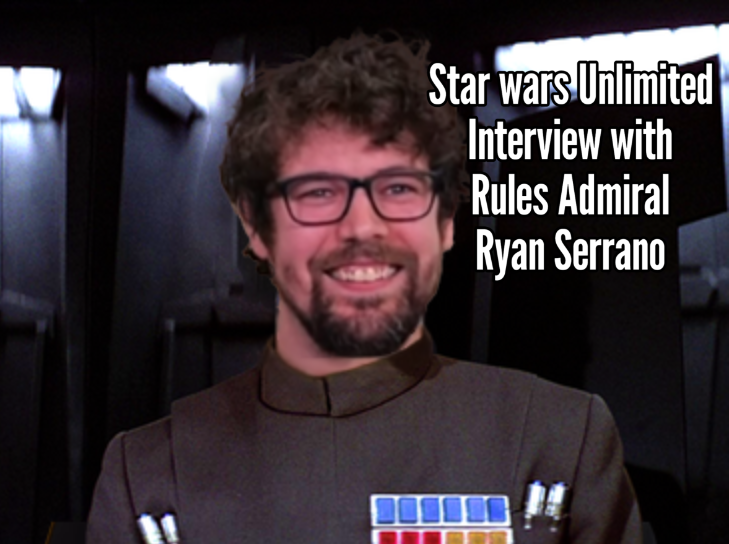
We had the chance to sit down with one of the Game Designers for Star Wars Unlimited, Ryan Serrano and ask him some questions! Ryan is more famous for his status as Rules Admiral and running the ship for Comprehensive Rulings for Star Wars Unlimited, but he also helped design the Twin Suns format! We hope you find the information shared with us as interesting as we did!
Let’s start off by telling us about yourself, Ryan! What are some of your hobbies and favorite things to do outside of work?
Let’s see, the biggest thing right now is that I run a trivia night here in Minneapolis – writing questions for that each week takes up a fair chunk of my free time, but I really love doing it. Outside of gaming, I’m a pretty big geek about Russian novels, animated television, and some non-superhero comics. I also love dragging other FFGers out for karaoke.
What is your background in game design? What is your background in the TCG world (playing or designing)?
I’ve been designing games since I was a kid, turning any school project with any degree of creative freedom into a board game (I remember one called “Ring of Fire” that took place on a giant papier-mâché volcano I made). I dove a lot deeper into the philosophy of game design after college, and spent most of my free time developing games either on my own or with a few other indie game developers. I’ve played a decent number of TCGs, including a few on the tournament-level, and was working on developing my own LCG when I was picked up by FFG for this job!
Of the three popular card game player archetypes, which do you most identify with (Timmy, Johnny, Spike)? How does the Star Wars Unlimited design team balance designing cards to cater to all player archetypes?
I consider myself a Johnny at heart – I don’t mind losing 90% of games I play if I can pull off the weird combo I found in the remaining 10%. Though I’ve been told that when drafting, more of my Spike side comes through!
I think we have a pretty good spread across the design team of people who get different things out of TCG’s, so that helps make sure everyone has something to love in a given set. As a specific example of something we do: after designing the leaders for a set, we figure out who on the design team feels drawn to that leader’s archetype and check in with them throughout the development process to make sure they’re still excited by that leader.
What is your favorite type of pepper?
Serrano, of course! Actually, my parents’ absolute sweetheart of a cat is named “Pepper”, can that be my answer?
What does an average week of working on Star Wars Unlimited look like for you?
A lot of it depends on what part of the pipeline the sets I’m co-leading are in! If one of my sets is in design, I spend a lot of time in the spreadsheets, coming up with new cards and adjusting abilities or keyword frequencies. If one of my sets is in development, I’m spending more time building decks, playing games, and managing playtesters. I try to attend our weekly internal draft, since it’s my favorite format. Oh, and I usually have a rules deadline coming up soon!
What most excites you about Star Wars Unlimited?
For me, it’s the skill expression. While the game is pretty easy to pick up and play, the back-and-forth action system means that resourcing, predicting your opponents’ plays, and sequencing correctly is vital to playing well. I almost always leave a loss having learned something that will improve my play in the next game!
We’ve been told previously you’ve been granted the title of “Rules Admiral.” How did that title come about?
I’ve always been very passionate about systems and structures, and I remember asking a lot of questions about rules minutiae in my first weeks on the job. When we needed someone to create and maintain the Comprehensive Rules document, I readily volunteered, and the rest is history. I remember at one time they were going to call me “Rules Lawyer”, but some folks have a very negative reaction to that term, so we settled on “Admiral” instead.
What exactly does a “Rules Admiral” do? Do you retain more of a responsibility to give a final ruling on all rules disputes, make sure the collective ruleset doesn’t contradict itself, maintain the comprehensive rules doc, or some combination of that and more?
You can think of the Comprehensive Rules document as my capital ship. I’m responsible for steering it through hurdles as we move from set to set, whether that’s maintaining internal consistency and robustness, figuring out what rules need to be adjusted to account for new mechanics, or catching new mistakes.
When we’re considering whether a card needs to change, I usually represent the perspective of the rules-iest possible player. I also sometimes suggest potential rules adjustments or clarifications, but any ruling we make is done with the whole team’s input.
Nested actions… how did they come to be? What was the thought process for designing the nested resolution?
The terminology around this was something we developed when trying to take all of the rules of the game that existed in playtesting and convert them into a document that could explain the game to fans who were just encountering the game for the first time. We wanted a system that was robust enough to handle a lot of possible situations in the same manner, while also working for the most part in the background. It isn’t necessary to fully understand how every part of the system works in order to pick up the game and start playing. We also wanted something that players would be able to apply to new situations relatively easily, even if there was a bit of an initial hurdle in understanding how it worked. What we ended up with is similar in many ways to the idea of depth-first search, which is (hopefully) relatively intuitive once you’ve grasped the core concepts.
In case you weren’t aware, there’s a popular meme in the rules questions threads on Discord. Are you overall satisfied with the reception of the player base to the nested action/abilities rule?
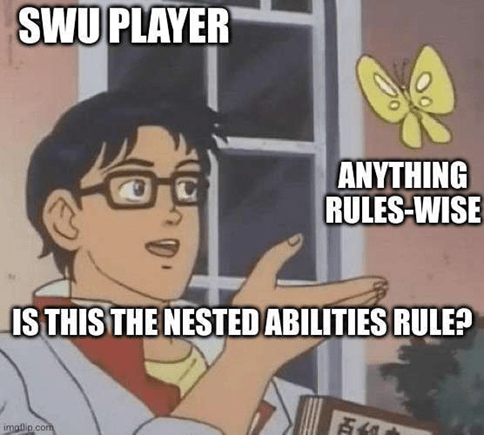
I hadn’t seen this, but I’m a very online person, so I always appreciate a good meme! We’re working on clarifying the nested abilities section in an upcoming rules update, which we hope will help players! (I should clarify that no rules regarding nested abilities are changing, we’re just adjusting the way they’re presented.)
Are you overall satisfied with the reception to the comprehensive rules as a whole? Is there anything you plan on explaining more in depth in future updates to the rules?
Overall, I’m pretty happy with it! I slept very poorly the week it was released, because I was so worried someone would find some interaction I had missed that would break the game, but to my knowledge, that hasn’t happened. The rules definitely will continue to be refined and updated with each new set. Now that it’s out there in the world and people beyond just us are interacting with it, we’re realizing some better ways we could phrase things to make it all more clear and helpful.
If a card or cards ever gets released the functionally breaks the rules, is there a philosophy on the design team to approach balancing/errata-ing/banning the card vs updating the rules?
There’s a lot that goes into answering that question! If it’s possible to update the rules so that it can handle some new edge case we didn’t anticipate, that’s usually the preferred method. We’d like to avoid errata/bans as long as possible, but if a card ever becomes egregious, it’s certainly something we’d consider. This is for balance errata – if there’s ever functional errata, I imagine we could be a lot quicker in responding to that.
What is one wild/bizarre/exciting rules interaction within the game currently that you personally love?
I’m not sure if it’s bizarre enough for you, but I really love to play cards with Ambush in my Cad Bane deck. Since Cad Bane’s ability and Ambush both trigger at the same time, you can often choose to resolve them in an advantageous order!
The initial release of the comprehensive rules is 56 pages. How much does that number matter to you? Is the goal to never approach a 200-page convoluted rulebook, or just to take up as much space as is required to clearly communicate how you intend the game to be played?
I’m not sure the specific number matters very much, though we certainly try our best to avoid too much bloat. We’ll always make it as long as it needs to be to comprehensively cover the game.
Do you work closely with the OP team on tournament rules, or are the core rules of the game your sole focus?
I’m pretty much exclusively concerned with the gameplay rules, and I don’t have a ton of visibility on the OP side of things. Occasionally I’ll be consulted on whether something makes sense, but tournament rules aren’t really my specialty, and we’ve got some great OP folks to manage that!
As one of the Junior designers, you were originally brought on to help design the Twin Suns format. What was the design process like? Were you given the parameters to design a fun alternate game format, or more specifically a multiplayer format?
We were given fairly free rein in designing the format, with the guidelines that it was supposed to be a multiplayer free-for-all. The order of design decisions might surprise some people, but we actually started with wanting it to be a Singleton format to increase variance and make it more casual-friendly. But we wanted players still to be able to build unique decks, even in Set 1, so we decided to give them access to 3 aspects instead of the normal 2 (plus Hero or Villain). From this, we came up with the concept of having two leaders to grant access that extra aspect, but we didn’t know whether it would play well – thankfully, it did!
How did the four of you work together? Was there one designer that took the lead on Twin Suns design?
No one was really in charge of the process. That system might not work on a lot of other teams, but all of my fellow designers are so easy to get along with and we were all just so excited to be designing together that it went really smoothly. We each would come up with ideas, then test them to see what worked. At one point, we made a spreadsheet with a bunch of alternatives for what became the blast/plan counters as well as the reward for taking out a player’s base. Then we just tested them all until we decided what was the most fun!
Who came up with the “Twin Suns” name? Were there any fun alternatives?
This was another case where we made a massive list of possibilities, whittled it down over the course of a couple months to a shortlist, then chose the final name from there. We actually had a few other frontrunners before settling on the final name, but we still might use them for other formats in the future so I don’t want to give them away just yet. “Twin Suns” was an option I came up with after a long weekend of thinking, trying to capture both the Star Wars feel and the biggest innovation of the format – two leaders instead of one.
What is your personal favorite leader combination in twin suns?
I’m a big fan of thematic pairings, so it’s hard for me to not play Luke & Leia in set 1. In honor of Set 2’s upcoming release, I’ve been playing a lot of Boba Fett (Set 2) & Fennec Shand, for both thematic and mechanical synergy!
Do you consider Sets 1-3 a Twin Suns lite experience until we hit Set 4 and get the 80-card deck rule?
In a way! You don’t really run out of cards in your deck in Twin Suns, so the jump to 80 cards mostly just increases the variance of any individual game. I’m excited for the jump to 80 cards, because I feel like then I’ll just have my official “Twin Suns” decks that hang out in a corner and I can update with each new set, but I don’t think the play experience changes too much.
Since Twin Suns was designed later in the design cycle of the game, can we expect to see more fun card interactions and design that are more focused on the twin suns format?
Yes, you definitely will see more designs that have fun synergies in Twin Suns! I’m probably more excited for players to find the leader interactions and decks we didn’t even think of, though.
One of Tyler Parrott’s favorite things to do is tweet little designer insights for Star Wars Unlimited cards. If you were to write one with Twin Suns in mind, what would it say?
Play politics aggressively! If you’ve got an ability like Set 1 Yoda, play him and then announce to the table, “Whoever defeats this Yoda, I’m letting everyone else at the table draw a card.”
What is your favorite way to play Star Wars Unlimited? Constructed 1v1, sealed, draft, or Twin Suns?
I’ll always be a drafter at heart! I love making deck construction into its own puzzle to solve – it’s like two games in one.
What would be your elevator pitch on why someone should consider playing Star Wars Unlimited?
Do you like Star Wars? Do you like games that have constant engagement with back-and-forth actions? Do you like a game that’s easy to sit down and play but still has interesting strategic options?
What card have players loved that most surprised you? What card that they weren’t fans of?
I’ve really loved all the memes surrounding Superlaser Technician, we knew it was a strong card, but I wasn’t expecting folks to connect with the art on that level! And then I was really surprised with the negative takes Iden got when she was first revealed – I think people were just really underestimating her ability to heal.
What is your favorite card in the game that you had a hand in designing (if unreleased, set # and card # please!)
There’s a Legendary Command/Hero card I designed in set 6 that has gotten exclusively really positive feedback from the team so far. I can’t say for sure what number it will be, but it will likely cost 5. More immediately, one of the first cards I ever contributed to was Set 3 #014, so I’m partial to that one as well!
What is your favorite art piece in Star Wars Unlimited? Set # Card # again if unreleased!
An impossible question! I know it won’t be everyone’s favorite, but Set 2 #176 genuinely always brings a smile to my face, so I’ll give it a shout-out as my favorite in the set.
What sets Star Wars Unlimited apart from other Trading Card Games to you?
To me, it’s really an amalgamation of the best parts of so many other games. I love having a leader to build around while also engaging with the back-and-forth action system. I also think it’s structured to create a nice on-ramp for folks who might never have played a TCG before. The fact that you can always choose to attack a base vs. a unit means you’re really engaging with the classic question of “am I the beatdown” on every turn of the game.
What advice would you give a new player on jumping into Star Wars Unlimited as their first trading card game?
Don’t sweat the small stuff, just grab a deck and start playing! You learn so much more about how to make decisions and sequence things correctly by playing the game than by strategizing around hypotheticals. Also, after each game, try to think of one thing you could have done better.
If you had to use one adjective to describe each person on the design team, what would they be?
- Danny – Dedicated
- Tyler – Versatile
- Jeremy – Wise
- Joe – Hyperspace
- John – Vigilant
- MJ – Intrepid
What is your favorite thing about working at Fantasy Flight Games?
I really love being around people who are this passionate about their jobs! FFG has a ton of great folks working with me who love games, and they’ve made me feel right at home even though I joined the team very recently.
If you had to spend a week locked in a basement with only tabletop games and 1 other person involved in Star Wars: Unlimited, who would it be and why? (Tyler picked you in a previous interview, but we won’t tell him if you don’t pick him!)
Well, if I’m already getting a week with Tyler based on his answer, I’ll choose John Leo. We’ve been tossing around the idea of playing some 10-hour board games for a while, so it’d be nice to be forced to actually sit down and play them. Plus, I know he’d smuggle in some great movies for between games.
Any last thoughts you’d like to share?
The single thing you can do to best understand how triggered abilities work in this game is to separate abilities triggering from abilities resolving. I’ve seen some players conflating the two ideas, and that usually leads to incorrect interpretations.
~~~~~~~~~~~~~~~~~~~~~~~~~~~~~~~~~~~~~~~~~~~~~~~~~~~~~~~~~~~~~~~
Big thanks to Ryan for answering all our questions and giving us a glimpse into what the Rules Admiral is responsible for. We hope some of his philosophy regarding rules will help out any who have been struggling. Thanks for reading!



 Garbage Rollers
Leave a comment