

When SWU launched, I wrote an article on SWU’s cost curve and how units from that set fit into it. Now that Twilight of the Republic is upon us, it’s time to expand that series with an examination of Set 3’s cards and mechanics. Let’s have a look at the new mechanics and cost trends hitting us this week.
As a reminder, the basic formula of the game goes like this:
A basic, 1-cost ground unit has four stat points. From there:
1 resource = +2 stat points = 2 direct damage = drawing 1 card = 1 shield = 3 healing
New Mechanics: Token Units, Coordinate and Exploit

Token Units – Twilight of the Republic gives us two token units – Battle Droids and Clone Troopers. Their costing is straightforward – 1 resource to create a 1/1 Battle Droid and 2 resources to create a 2/2 Clone Trooper. However, the designers have gifted us multiple cards that will improve on this standard rate- like Captain Rex (unit) who recruits clones at 1.5 resources per helmet and Poggle the Lesser who manufactures droids essentially for free. There are also efficient leader-based methods for making tokens like Captain Rex (leader) and Nute Gunray. These abilities don’t require cards from hand to activate so deserve extra consideration for conserving those plays. As we look at the other two mechanics in this set, keep the input costs of making tokens in mind.
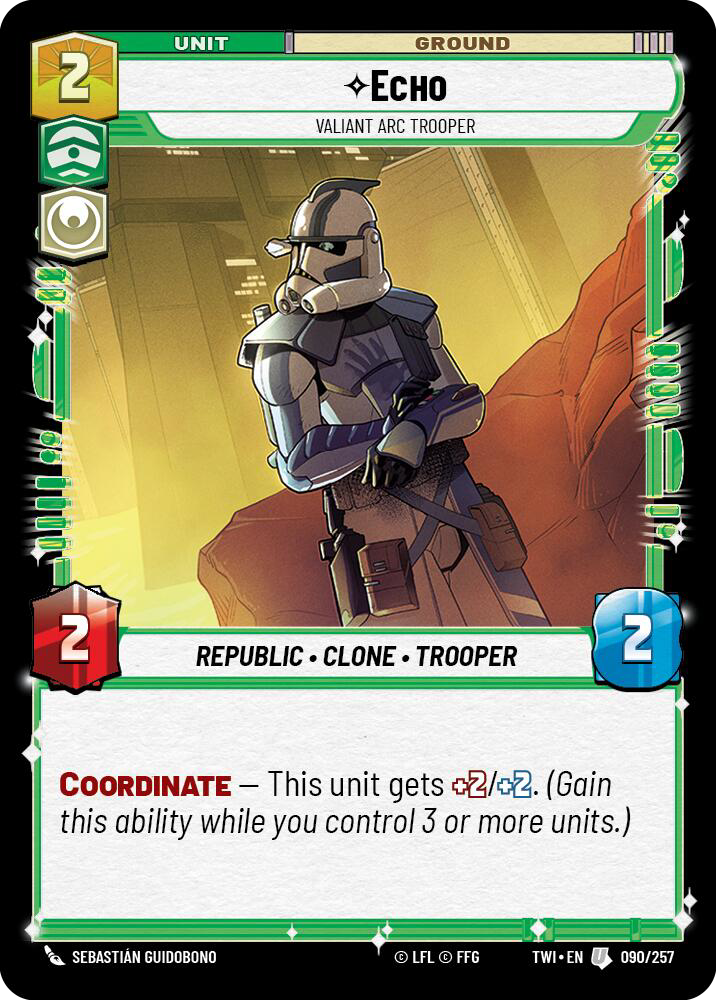
Coordinate – The Coordinate keyword requires you to have three units in play in order to activate the Coordinate ability. Since you can’t always guarantee this, Coordinate abilities need to be discounted versus a regular ability. The heuristic I’m approaching this with is that a Coordinate ability should cost half as much as a regular one. Ideally, a Coordinate unit will be below curve when the keyword is inactive and above with it on. Echo (above) is a good example of this. Unfortunately, the designers have given us a lot of units with Coordinate that start below curve and end on it when the ability is activated. These won’t be playable.

Exploit – The Exploit keyword allows a player to sacrifice a unit they control to discount the cost of a unit by 2. Since the designers assumed a cost of 1 for producing a Battle Droid token, the basic math was that each instance of Exploit would reduce the total cost to play a unit by 1. To keep Exploit units from being broken, they adjusted the printed cost of the cards up. Put another way, each digit of Exploit on a card will raise its printed cost by 1. This is a classic risk/reward mechanic: if you have the cheap units to sacrifice, you’ll get something under-curve; if you don’t, you’ll be overpaying for those units.
Going from Odds to Evens on the Curve

When SWU started out, we began with the assumption that the cost curve began at 3 stat points for a 1-cost unit and proceeded linearly upward from there. This meant that cards like Battlefield Marine and Boba Fett were outliers. What’s become clear over three sets now is that this wasn’t the case. The curve, is in fact, on the even numbers, and instead of units having 3/5/7/9 stats for 1/2/3/4 cost, they should have 4/6/8/10. This means we’ve had to reexamine how keywords are costed, with most of the standard ones (like Overwhelm or Saboteur) costing a stat point instead of being “free”. If you’re a former reader of our original article evaluating the cost curve, it’s undergone a significant update to reflect this.
The Best and the Worst
Now that we understand the new dynamics of Set 3, let’s take a look at what cards might be over or under the cost curve for this set!
Undercosted: Cad Bane

Cad has what would be respectable stats for a 6-cost unit. This means ALL of his capture abilities are being costed at a rock-bottom 1 point. The “standard” costing for capture effects is 3 points each! Now, this formula didn’t prove to be a winner in the Shadows of the Galaxy meta, where even cards like Relentless Pursuit that functionally captured for 2 resources didn’t fully take off… but even still, Cad’s cost seems absurdly low.
Overcosted: Planetary Invasion
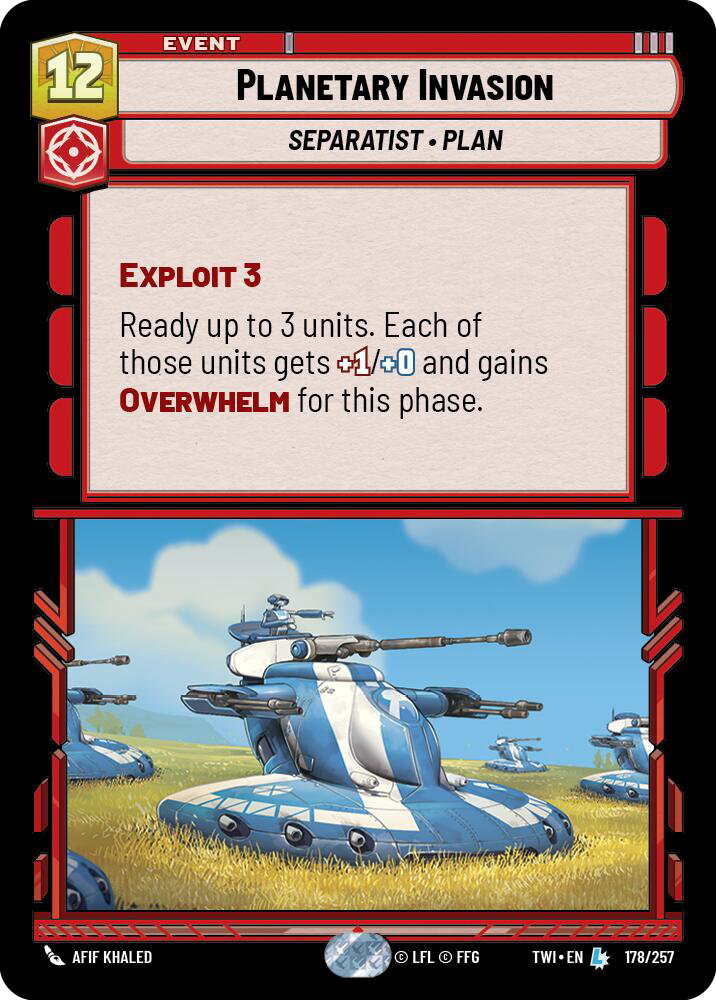
It’s odd to see a Legendary make the “Least Cost Efficient” list, but here we are. As we discussed earlier, a Battle Droid costs ~1 resource to produce, so the least total cost you’d expect to play this for is 9. Readying a unit is worth 1 cost each (value of 3) and giving three units +1 and Overwhelm might be worth 3 more (for 6 total), but that doesn’t even approach breaking even on value. Not to mention the ability is a highly situational one where you’d need three worthwhile, exhausted units in play. Not gonna happen. I’m fairly sure uncommons in this set will command more $$ than this legendary.
Undercosted: Grevious’ Wheel Bike
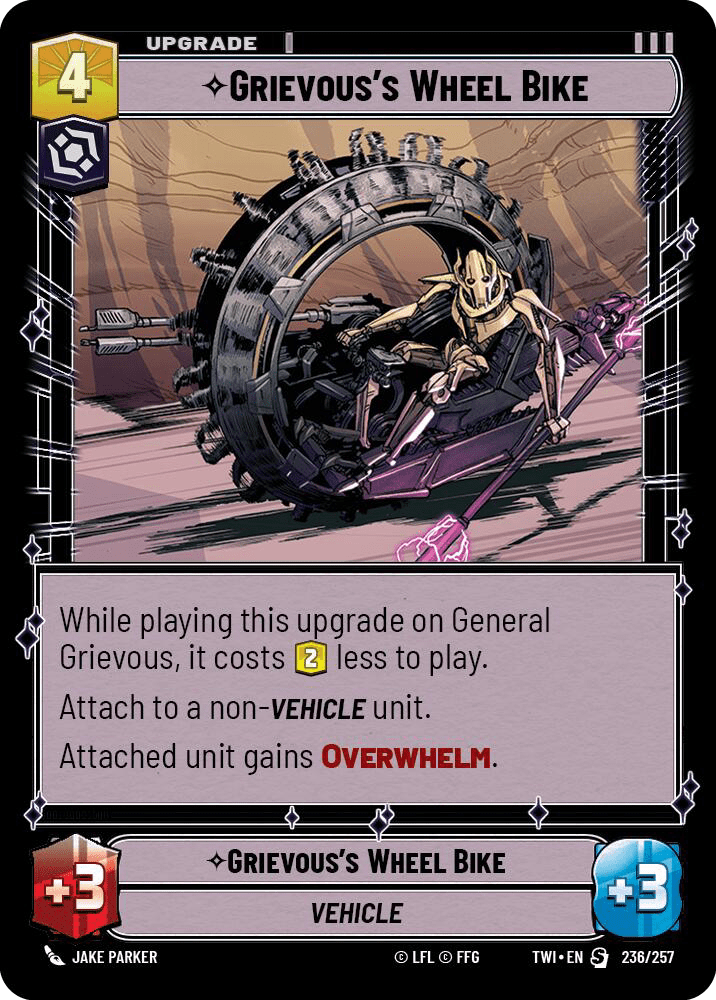
This one is pretty straightforward. Provided you can get this upgrade down on General Grevious (leader or unit), it’s providing you 3-cost worth of upgrade power for only 2 cost.
Overcosted: ETA-2 Light Interceptor
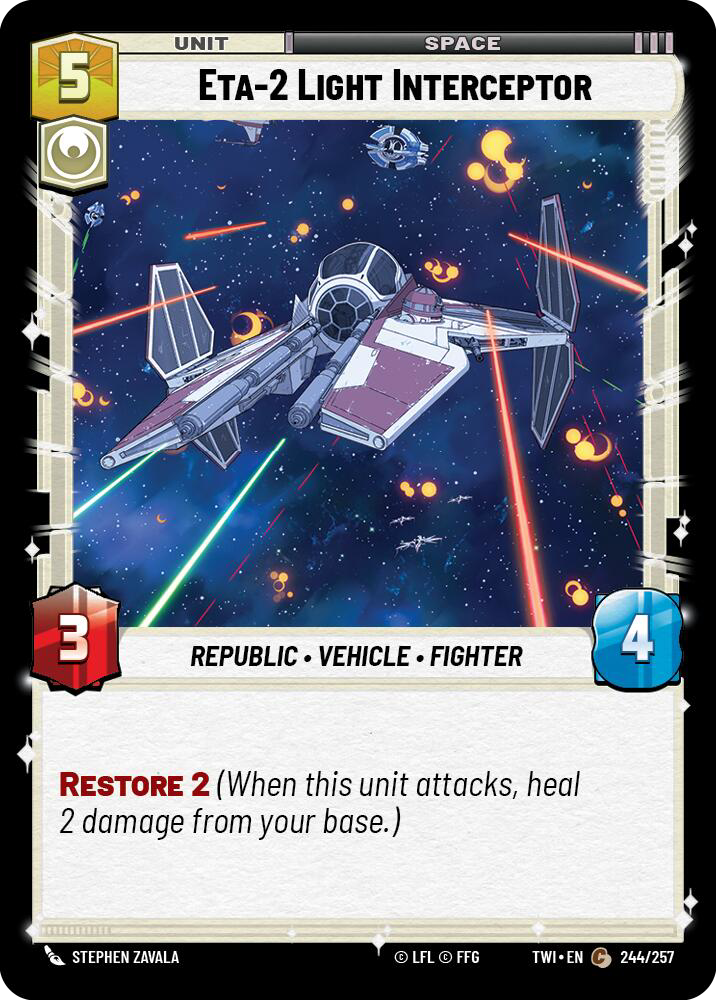
Space units will generally have 1 less stat point for their cost than ground counterparts. So, a 5-cost space unit should be giving us 11 stats. This unit, however, sports only 7. While it does effectively add two more with its Restore 2, that’s not enough to save this ship from being a full point overcosted.
Undercosted: General’s Blade

The +3/+3 for 3 is precisely on-curve, which means all the text is coming for free. While it’s only relevant on a Jedi unit, the discount is powerful and presents the opportunity to earn back two resources the turn the upgrade is played. That’s major value!
Overcosted: Republic Defense Carrier

The stats and abilities here certainly don’t equal the Defense Carrier’s printed cost of 11. But what about with the discount? A 6/7 space unit with Sentinel should cost us 7 resources. That means our opponent will need to have at least four units in play for us to get on-curve value from this card. It seems unlikely that the Defense Carrier could make a difference in a game you’re already losing that hard.
~~~~~~~~~~~
Thanks for reading today! Please reach out to @DJStormtrooper on Discord with your thoughts.




 Garbage Rollers
Leave a comment