
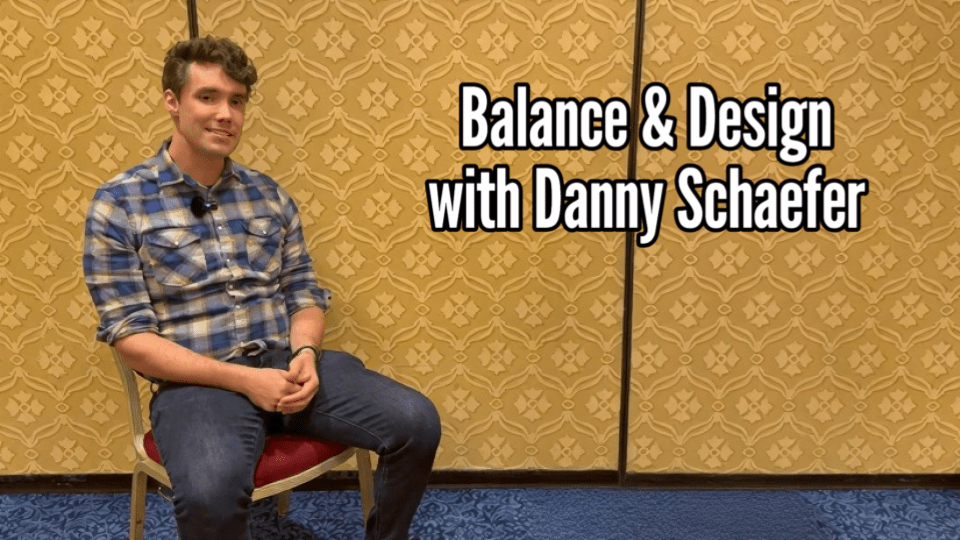
Good morning! While at the Galactic Championship this past weekend, we sat down with Game Design Lead Danny Schaefer and discussed SWU design, balance, and several other topics. Feel free to watch the interview, or read the transcript further below!
Justin – What’s up everybody everybody? It’s Justin with the Garbage Rollers. I’m here with lead game designer Danny Schaefer. How’s it going?
Danny – Good.
Justin – How are you doing today?
Danny – I’m doing great. It’s just so exciting to be here at the Galactic Championship.
Justin – Yeah, it’s day one of the Galactic Championships. We’re 3-4 hours into the main event. Have you been able to make it down there and look at it any?
Danny – I’ve been around the halls a lot. Yeah. Playing some games with people, doing designer duels, signing some cards and walking around a little bit just checking out the stage and checking out the tables. It’s a lot of fun. It’s just so cool to see 2,000 plus people here playing in the main event and a bunch more just hanging out, playing side events.
Justin – If there was ever a celebration of Star Wars Unlimited, here it is, right?
Danny –Yeah. Yeah. This is fantastic!
Justin – Cool. Well, I’m sure most people know you by now, but can you introduce yourself? Talk about what you do for SWU, your past game design experience, and any hobbies.
Danny – Yeah, sure. My name is Danny Schaefer, as you said. I’m the design lead now for Star Wars Unlimited. That means I’m taking the highest-level view of game design. And we’ve got a bunch of other designers and developers working hard on the various sets coming in the future and I’m kind of watching over everything, making sure it all fits together well.
My history is I’ve been at Fantasy Flight Games for just over a decade now. Got my start uh working on Game of Thrones LCG primarily and Key Forge was the other one I worked on a lot before diving into Unlimited about five years ago now, which is kind of hard to believe.
Justin – Time flies, right?
Danny – Yeah. Yeah. And outside of outside of work, obviously play a lot of games. I’m a big sports guy. Play a lot of volleyball. Basketball.
Justin – Top Gun volleyball?
Danyn – Top Gun kind of volleyball or sometimes, you know, we play out in the sand on the beach. Yeah.
Justin – Cool. Well, we’re about a year and a half into SWU now. There are five sets. Do you feel like the game’s where you want it to be, where you envisioned it when you started out?
Danny – I feel like the game has really come into its own. The more content we’ve gotten to produce and the more different themes we’ve gotten to explore. Honestly, in terms of the player base and the fans being here at the Galactic Championships, it’s really exceeded all my expectations. I think when I first had this idea when I was working with Jim on the very early designs, never could we have dreamed of this. We never could have really fully believed that we’d have this many people just help with the game.
Justin – It’s awesome. I mean, this has got to be FFG’s like biggest event ever, right?
Danny – As far as I know, it does seems like it. Yeah, certainly biggest tournament I’ve ever been to. We’ve come a long way from the old Worlds events at the game center in Roseville. So, I do I think back to those sometimes. We’re in Las Vegas now. It’s wild.
Justin – What would you say high level has been your biggest design success so far with Star Wars Unlimited?
Danny – I think the biggest thing for me is I think we hit that original goal of a game that is easy to get into that so many people I meet have never played a trading card game before. This is their first trading card game. You see people playing with their kids, playing with their partners who haven’t been in it as into games and it’s just really cool that that those people are able to get into the game, but at the same time we’ve got a clearly a bunch of higher level competitive players who also find a lot to really sink their teeth into. So I think yeah- we hit that that high level of a goal.
Justin – Yin-yang: do you feel like there’s been a biggest, not like failure, but low point in the design process?
Danny – Yeah. No, nothing that I would say is a true failure but Shadows and Twilight especially we were really stretched a little thin and I don’t think those sets quite hit as much as we wanted to for competitive play. I think they hit a lot of themes that people loved. I still talked to a lot of casual players who were like, “Oh, I love all the Clone Wars stuff in Twilight.” But didn’t quite land in the competitive scene and shake things up as much as we would have liked.
Justin – Makes sense.
I mean, obviously the whole design team loves limited play. I think ya’ll have like a draft weekly.
Danny – We do. We do have at least one draft weekly.
Justin – Y’all said the game’s been designed kind of from the ground up with that in mind. Do you feel like that philosophy kind of detracts um, Premier Play sometimes?
Danny – Oh, no. I don’t think so. I think that they complement each other. It’s sort of a reality of trading card games that there’s only going to be so many cards that you can make truly like viable in competitive constructed premier play. Limited just gives another avenue where we can have other cards that more lean towards draft and sealed and just give people more options, more variety of how to play the game. And I think yeah, I don’t think they have to pull each other at all. I think I think they can work together.
Justin – Cool. I mean, speaking of variety, we have five different ways to play the game now. Sealed, Draft, Premiere, Twin Suns, and now Trilogy. Do you feel like just finding a balance between all those five formats and card design is more difficult? Is it a puzzle trying to piece it together to work for all five? How does that work out?
Danny – Yeah, it’s a it’s a puzzle, but it’s a fun puzzle to solve, I’d say, because um, you know, it lets us have cards that don’t all have to be geared in one direction. We don’t have to say every single card has to be that top level premier card because maybe it has a home in Twin Sons. Maybe it’s something that works better in multiplayer or maybe it’s something that’s just like a perfect card in in draft or sealed. Uh and so it’s yeah, in some ways it’s it’s kind of freeing to have that possibility of each card can find its own own niche in a different area.
Justin – Do you kind of design cards specifically thinking like, oh, this is going to be the twin suns card or is it just kind of how it plays it out at times?
Danny – Yeah. Um we definitely will look at certain formats. And sometimes it’s a little both. Sometimes it’s we go in from the start saying this card is clearly going to be great in Twin Suns, we’ll just design it for that. And if we can have it, you know, also, you know, we like cards that do multiple things. If it can also work well in draft or also work well in Premiere, right, all the better. Um, but at other times it does, you know, it it kind of just falls into it where we’re play testing and far into play testing. We’re like, you know what, maybe originally we thought this was going to be more of a competitive card, but the way the metag game internally is shaking out, actually this is more of a a Twin Suns card. Maybe we can lean it more in that direction.
Justin – Okay, yeah, very cool. Um, you know, kind of backpedaling to Y’all love limited play. Do you ever see that making its way into competitive play?
Danny – Uh, yeah, actually. So, I think uh season one of organized play is going to put uh not at the expense of Premiere, but there’s going to be more opportunities for limited in competitive play side by side with Premiere. And I think it’s it’s going to be really cool. Uh again, we know there are players out there that’s their favorite way to play. Yeah. Um and giving them an avenue to be really competitive with it is gonna be gonna be exciting.
Justin – Do you think there’s a world where we come to the Galactic Champions next year and there’s limited play happening?
Danny – Yeah, I think it could be a component of Galactic Championships for sure.
Justin – Very cool. Um with the continuing expansion of the design team, I mean, y’all are up to I don’t know, couple dozen almost.
Danny – I can’t keep track anymore, but yeah, it’s at least one dozen, I think.
Justin – How has your kind of uh lead design role changed over the last five years?
Danny – I guess it’s really Yeah, it’s changed a lot. It’s kind of wild to think about back to five years ago, as you say, where I was kind of doing a little bit of everything on the design side. I was so heavily involved. Every single card that was designed, it was like either I I personally designed it or I had a heavy hand in it where, you know, someone else came up with the idea, but I was play testing, balancing, changing that card very directly. And as the team has grown, as the game has grown really, um my personal role has gotten much more to be the again the person with the high level view. Uh I’m still play testing every week uh various amounts depending on what I have time for. But um I’m not really personally designing as many cards. It’s a lot more like, oh, that’s a, you know, that’s a a John design, that’s an MJ design, and I’m I’m playing with it. I’m making sure that everything’s fitting together across the the grand scheme of things. Um, but I’m not as heavily involved in, you know, my day-to-day is not just designing cards and playing with cards all the time. It’s a lot more uh overseeing things, communicating, uh, thinking a little bit about the the bigger picture strategy stuff.
Justin – So, I mean, your role’s kind of shifted into a blend of that designer and developer aspect?
Danny – Yeah, a blend of design, development, and also some mixes of some some other roles probably uh, on you know, the product strategy side of things. So, yeah, a little bit of everything now, which is kind of fun. It’s kind of a new a new challenge, a new puzzle to solve.
Justin – So, I guess with being the lead game design, uh, or whatever you said the role was, I can’t remember. Um, how do you kind of monitor Power Creep as you go along? Obviously, you have different sets of guys designing each set.
Danny – Um, yeah. Yeah, it’s something we try to be very vigilant about. Um, and we have sort of we have baselines established even from back in Spark of Rebellion of um, we want new cards to be powerful, new cards to do things that you haven’t seen before. Um, but when you look at them side by side with the existing cards from the first year of the game’s life, it’s not just like a clear, oh, this one’s just better than this one. It’s like, oh, this is asking you to do something different in your deck building. And if you do that, you get a bigger reward, or this one, you know, maybe this one has a higher floor, but not as high of a ceiling. Yeah. really be conscious of uh the comparisons between the sets.
Justin – What does an average 40-hour week look like for you? Uh, is it limited to 40 hours?
Danny – It is actually I will say yeah very good about that at FFG in general. Um with the exception of weekends like Galactic Championships where we’re doing a lot of different stuff. We want to be out there with the fans as much as possible. But um I would say that that as my design lead role has evolved there’s really no such thing as an average week. Uh every week is very very different. Um, but I can give you, you know, some examples that, you know, some weeks it’s much more uh, especially when a set’s like, you know, uh, really getting into like an important stage of development. I’ll be much more involved directly with the designers. I’ll be having meetings with the designers on the current sets, making sure everything’s where it needs to be. I’ll be spending some time uh, building decks and playing games. You have a couple days that we’re all in the office together, always, you know, play testing. So, I’ll try to make it to those. Um, other times though it’s it’s kind of the other side where I’m in a lot more uh high level strategic meetings. I’m thinking about what’s going to happen, you know, three years down the road, five years down the road, planning that kind of stuff. Um, and a little further away from actually playing with the cards. Um, and of course some some weeks are like this where I’m, you know, doing things uh with an event or, you know, going on a live stream doing things like that. So it’s it’s a fun variety. But yeah, no such thing as a a typical week anymore.
Justin – Very cool. Are you all having to fly to Gen Con after this?
Danny – Uh, most of us get Gen Con off. There going to be a few unlimited designers out there though. And I am I think I’m heading out just for a day or two and then heading back.
Justin – How do you plan to keep the complexity from getting too extreme as you continue to introduce new keywords, new concepts, mechanics, stuff like that?
Danyn – That’s a great question. Something we think about all the time is making sure that someone who starts, you know, someone who comes into the game right now with Legends of the Force or someone who comes in three years from now with whatever, you know, the 15th set is um that they don’t have a higher barrier to entry than someone who came in right with Spark that they can just come in and it’s still the same game. It’s still, you know, there’s going to be different mechanics, but not just like a ballooning of complexity. So, we have a variety of ways we do that. One is just being cognizant of how many mechanics we to exist in the set. That’s one of the reasons that, you know, we keep it to a couple of new mechanics every set and not just like bringing back all the old mechanics. We want to make sure that if you’re learning the game for the first time in say Legends of the Force, it’s not like, oh, there’s there’s twice as many keywords as as there were in Spark and I have to learn them all right now. You can sort of learn them as you go. You can start with one set and then add the others gradually. Um, and we have a lot of internal metrics too where we um we’re keeping track of how many just, you know, vanilla units or or units that are French vanilla just for the keyword there are, especially at common. We’re keeping track of how many words are on a card, how many lines of text, make sure that’s not changing radically between sets. Um, and as much as possible, it’s getting harder, but as much as possible, we try to um keep putting the game in front of people who haven’t played it before. Find new players, find people who haven’t seen it, and make sure, hey, are we still meeting our goals? Is this still easy enough to learn? Right. Uh it is a challenge now though because a lot more people have played Star Wars Unlimited which is is exciting.
Justin – Yeah. I think you kind of answered the next question, but um one of the common complaints is the the design themes around mechanics and keywords have kind of been limited to a set for the most part outside of that first set. Is that kind of going into the hey we want some of these to rotate off so we keep the number of keywords down and stuff like that?
Danny – Yeah. And it’s a balance we want to strike because we want to keep as I said the complexity down. We don’t want there to be suddenly 20 keywords in the set or you know here’s the force mechanic and pilots and you know unit tokens and all in one set together. Um, so we try to keep each indiv individual sets complexity down, but there is a balance there because there are things we can do to support those old mechanics, which, you know, I think at times we’ve done better or worse at that, but it’s something we’re, I think, more cognizant of than ever, and we’re going to keep trying to do that where it’s like, uh, I mean, you think at of a card like the invisible hand where they came out after Twilight, but it’s like, oh, this goes with a lot of the Twilight cards, you know, something that can support droids without having to have a a whole, you know, all the set mechanics on it.
Justin – Yeah, Tyler loved playing the invisible hand with triple dark raid and getting all the vulture droids. Yeah, he was all about that.
Danny – That was so cool. You know, when we suspended triple dark raid, Joe O’Neal designer was heartbroken because it really nerfed his Watt board deck.
Justin – Um, what’s your process when you design a new keyword or mechanic? How do you test whether it’s thematically appropriate, maintains a good balance of complexity, and isn’t too weak or powerful?
Danny – That’s a great question, and it’s obviously a bit different for every keyword. Uh but in general uh we you know our designers will be brainstorming, pitching new ideas and you know we have a sense we’ve designed a lot of card games before of oh this seems like it’s probably going to work pretty well unlimited. This probably isn’t. And we start with um we start with design testing. We start with just playing games and seeing is this fun? Does this like does this feel like unlimited? Does this feel like a cool thing to do? And not worry about balance at all right at the start. We just yeah get games going to see like what’s the play pattern like? Is it good? And then once we’ve settled on that, which usually involves some amount, you know, sometimes we we hit it right away and it’s like, yep, this mechanic is perfect. But more often than not, it’s either uh we have to make some small revisions. We have to say, oh, maybe, you know, maybe this is supposed to work a little bit differently, maybe we can clean up how this works, or, you know, at times cut a mechanic, come back with a different uh version of that mechanic is kind of trying to hit the same themes. Mhm. Uh and once we kind of have a place where it feels right, where it feels fun, then we sort of do the transition to development and we’re like, “Okay, now how do we balance this? How do we make sure this is this is fair and competitive play?” And it’s a it’s a conversation though too because obviously there are certain mechanics that the dev team can look at earlier on and say this is, you know, a red flag that it’ll be hard to balance this if we keep it this way. That’s maybe, you know, maybe give us a knob to turn, maybe put a value on that keyword so we can dial it in or something.
Justin – Yeah, awesome. Um, kind of in that same vein, how’s the addition of game developers kind of helped the design process because that’s still pretty new
Danny – It’s been a huge huge boon to us for sure. Um, I mean, just having more people on the team in general has been great. Both designers and developers, but having people dedicated specifically to development is great because they can just really focus on uh play testing the sort of future uh the future metag game whether that’s for Premiere or or Draft and Sealed um and not have to at the same time be balancing like oh and I’m thinking of ideas for a set you know another six months or a year down the road from the set we’re balance testing right now. So much of the before we had developers, it was, you know, some of us would try to focus on the premier balance testing for the set that was coming right up, while other people again had to be starting a set way in the future. And it was it was a lot a lot more challenging. And I think, you know, some of the development and balance challenges we had uh in the early sets are probably probably due to that. But yeah, the the developers are all great and they’re all just really uh strong competitive players, players with a big background in competitive trading card games and they’re just laser focused on on balance for the future premier formats. So I think uh balance is going to keep getting better and better as time goes on.
Justin – Yeah, that’s awesome. Um I think it was Tyler that said it whenever Jango Fett kind of became a problem is you had originally had Boba1 as the counter, but obviously the way the meta played out, Boba1 got suspended.
Danny – Exactly.
Justin – So, in that similar vein, is there any cards on uh in set six already that you’re kind of like, okay, we need to be worried about this?
Danny – I wouldn’t uh I don’t think I can speculate about any specific uh cards coming with Secrets of Power yet, but there are certainly um you know, strategies that have have been near the top of the internal testing and that we’ll you know, we expect to be strong but not too strong, but you know, we’ll obviously have our eye on them.
Justin – Yeah. Cool. Um, has the design philosophy changed at all due to play patterns and tournament results as the game has gone on?
Danny – I would say the overarching, you know, the main philosophy is still the same. We’re still trying to aim for the same general things. There’s probably some smaller specific points of how people have played that that definitely influence us. Um, you know, we maybe certain types of cards that we thought were stronger before the game came out and now, you know, we think are a little weaker and we we’re willing to take more risks with them or vice versa. Um but yeah, the biggest thing is we do like you know watch how people are actually playing the game of practice and adjust so that with the caveat that adjustment is always going to be really slow. Like I think about still uh you know even at the time Spark of Rebellion first came out. You know we probably had a little time to make changes on Legends of the Force at that point but nothing big or sweeping. You know the other three sets before that were all locked in and Legends of the Force was most of the way through. So we could, you know, change some balance on it, but not change the the broad strokes of the set, you know. So it uh, you know, we are always adjusting and and course correcting where where we need to for fans, but it’s a, you know, it’s a big ship and it doesn’t always turn as fast as we like.
Danny – Yeah. Uh, what’s your favorite type of card game player to design for? Do you you know, you enjoy designing for the competitive player, the limited player, the guy that puts all the weird cards in his deck?
[Laughter] I wasn’t pointing at you, YouTube. I was pointing at Tyler, just to be clear.
Danny – All right. Uh, that’s a great question because I personally I think the cards I’m drawn to the most are the competitive cards. I I like to, you know, I I play to win, I play to compete. I like competitive cards, but when I’m designing, I find it almost more fun to design for the uh Yeah. the like kind of weird combo player, the player who’s trying to do something unusual that no one’s ever seen because those cards are just like they’re just exciting, you know, the possibilities with them.
Justin – It just takes me back to that stream you were playing against Tyler and he brought like Sabine ECL and you had a Nala Se deck and you just blew his mind. It was great.
Danny – I did love that Nala deck. That was a lot of fun.
Justin – Do you feel like the competitive meta has finally landed in a kind of where you intended it to be? You know, we’re kind of in a place where we’re getting more units sticking to the board and doing that back and forth action y’all described early on.
Danny – Yes, I would say in in that way. Uh certainly we uh really always envision the game as being you know not like units are around forever but you know you have units sticking in play that the back and forth actions really shine as you say where there’s multiple choices in combat. There’s choices of when to play your events, when to attack with the unit and it’s really that’s that’s the heart of unlimited. That’s where where it really really shines. So, uh, in general, especially with Legends of the Force, I think we we’re getting to a point where the game play is looking a lot, uh, a lot like how we want it to look. I think there are still, you know, maybe specific decks or archetypes that are are a little bit outliers that that we can dial in, but the broad strokes of the gameplay we’re feeling really good about.
Justin – Cool. Yeah. Um, how do you expect the game to change after rotation?
Danny – I’m I think it’s going to be a massive change, obviously. Um, especially Spark of Rebellion has casts a long shadow over the game. I mean, it feels like we still play decks with half the cards from SOR. So, yeah. Yeah. So, those cards those cards going away will be a big thing. And then, uh, also the new the new cards coming in both with uh, Secrets of Power coming out and then A Lawless Time is going to do some really I can’t say anything about what’s in it, but it’s going to have some really cool stuff that’s going to really change change how you how you build your decks.Yeah, I think it’s going to be a very a different looking format and one that will, I think, make people re-evaluate a lot of the cards from Jump to Lightspeed for sure. Probably from from Legends of the Force and Secrets of Power as well because I just, you know, in a different context without Spark and with new cards to work with. They they just they’re they’re different. Yeah, I feel like that’s always an interesting design point is when you get to that point where, oh, I need to go back to my old boxes and look through these cards again and see like, oh, these can have impact now with what these new cards have brought. And rotation brings a good part of that.
Justin – Do you think we’ll ever get another set like SOR that just felt like it was, you know, kind of power level a little bit higher than everything else?
Danny – That’s an interesting question. Um because in some ways the way we talk about it internally is more so we want more of our sets to be closer to Sparker Rebellion. Not on the same level as Sparker Rebellion as far as you know being so far above the other two sets but if you know every set could be you know 80% of the way to Spark or whatever. Sure. And then all the sets are like that. So they’re kind of there’s more uh balance between them as far as what cards you see in play. I think that’s kind of the way we think about it.
Justin – Okay. Yeah. Um, how do you feel like the design team has handled balance and the suspended list thus far?
Danny – Oh, yeah. We’ve we’ve been happy with the handling of it. Um, obviously, you know, never feels great to have to suspend a card. Yeah. Uh, but I think each time we stepped in and did it, it was uh pretty necessary to make the metagame feel more more fair. and the, you know, both after we suspended Boba Fett and then after the the second round of suspensions around uh Jango, Triple Dark Raid and DJ, um I think the the metagame and the decks we saw right afterwards uh were much more diverse and uh that’s really all we can ask for is is for the the metagame to look better after we step in and take action.
Justin – Just looking at it from a high level, it feels like y’all have taken a very reactive approach to um balance and kind of in the sense of we want to get the data before we make uh any kind of changes. You know, we’re not going to go on what we think’s going to happen. We’re going to wait and see what actually does happen. Um do you like that approach and you’re going to stick with it?
Danny – I would say generally yes. Um, we uh we don’t want to just say, “Oh, we think this is we internally think this is going to be good.” And just assume that that’s that we’re right, and take action before players even had a chance to play the cards, you know, or or really play the cards in a big competitive setting at least. Um, we do want to act quickly though. We don’t want people to have to sit around in a imbalanced or a sale format for very long. Um, that’s kind of what we did with um, especially the Jango Triple Dark Raid uh, DJ where uh, you know, we let a few a couple of big competitive events play out to make sure like there isn’t a counter out there that we’re not seeing or something that we’re missing. But then as soon as it became pretty clear after a couple big events, we said, “Okay, now let’s step in. Let’s make sure that the PQ season and and the later events are not affected by this.” Um, so it’s generally I think about what we’re going to do.
Justin – Do you think there’s like a threshold of we got to hit this before it happens kind of thing or is it always going to be that?
Danny – It’s hard. I mean you can imagine a hypothetical situation where there’s just, you know, a really egregious combo that we didn’t catch where maybe we would, you know, then step in sooner. But um in general, you know, if it’s if it’s something where it’s just like, oh, this seems like a the strongest possible mid-range check, but maybe there’s a counter to it, we’ll at least give it a little time to to play out and see what the players can do.
Justin – So, kind of going off of that, how would you respond to the players that are kind of disappointed that, you know, they’re traveling to an event early in the meta and there might be a problem that, you know, they perceive, but you’re going to wait to react to it until later.
Dany – Sure. Uh, yeah, I get that. I get that feeling for sure. I think particularly like with, you know, Galactics, we’re coming what, threeish weeks after uh Legends Force actually came out. I think that’s a good spot where there’s been time to test. some time to to see what’s out there, but there haven’t been any big events yet. And I have a feeling that at least some of the competitive players are going to come with some surprises that they’ve been holding for Galactics. And I think that’s cool. I think it’s cool to go in thinking maybe there’s a specific deck that that is really good or specific card that’s really good, but it has a target on its back and people can come and try and try and play for that. Yeah. Um and honestly, like at least from the breakdown we’ve seen so far from uh day one, it’s it’s a pretty good variety of leaders at least. I know there are certain certain cards, certain archetypes that are that are up there and obviously um uh Shadows Han Solo is is 20% of the field, the biggest, but the rest of the field is I don’t think there’s anything else above 10%.
Justin – Yeah, Vader was the next highest at seven.
Danny – Yeah, Vader uh Mother Talzin was way up there. Kylo was pretty high. And there’s two different versions of Han as well because the green version was up there, too. So, it’s it’s cool. I think it’s a lot of possibilities as far as what could end up taking down the tournament.
Justin – What kind of led to the decision to not carry over the current suspended list of the trilogy format?
Danny – That’s actually uh unfortunately something I don’t have a ton of insight into. There were kind of other people on the team really driving the trilogy format and I was sort of again pretty far zoomed out on that. So I don’t uh I can’t really talk the specifics of cool of those. I think we can expect uh if it plays out that certain uh certain strategies or or cards are are dominant there, we could see some balance updates just as we had to do with premiere.
Justin – Alright, what’s your favorite thing about the trilogy format?
Danny – I think my favorite thing is uh just the fact that like you can’t play the play set of a card across all three decks. So, you kind of have to make some unique deck building decisions as far as uh what do I prioritize? To use a relevant current example, you can’t just like play three force throw decks. You have to say, okay, do I want to play just a totally different color combination? Do I play a good deck, but it’s, you know, maybe missing one or two key cards because it’s from this other deck? Do I split the cards between those decks? Um, I think that’s a lot of fun. Um, and I also think the the uh ban system where you ban one of the decks beforehand creates some really fun moments and storylines where it’s like uh I know when we were testing it internally, there were certain decks that we knew some of the devs were really comfortable with and we say, “Oh, we can’t let you play that.” And then the or you say, “Actually, I am going to let you play that. I think I can beat that deck. I’m going to ban this other deck.” And it’s it’s kind of fun. It creates a little narrative to the whole uh little game within the game.
Justin – Very nice. You know we’re we’re going to see limited in competitive play soon, do you think we’ll ever see trilogy?
Danny – That’s a great question. Um I think always probably premiere is going to uh be more of the uh format from competitive play just because it’s a lower barrier to entry by three different decks. Yeah, it’s a lot more accessible. Um, but I can see, you know, Trilogy finding a home in in various levels somewhere. Um, very cool. Not totally sure though. We’ll see.
Justin – Um, now we have, you know, like we said earlier, five or six different ways you can play the game. What’s your personal favorite?
Danny – I am just such a fan of just playing straight up Premiere.
Justin – Really?
Danny – Yeah, that’s my favorite way for sure. Um, I just I don’t know. The deck building is really fun and I’m just I’m a competitive guy and I love the the head-to-head games with a deck that I you know I built and I got to spend time tuning. It’s just like it’s what I love about trading card games.
Justin – Yeah. I feel like most people are “I love the deck building” or “I really love the playing.” There’s not like a huge balance in between there and you feel like you’re the 50/50. I love both.
Danny – Yeah. I just love both. And there’s something too about like you built your own deck and so you know how to play it and your opponent doesn’t necessarily know all the lines and you can feel like you have like a play edge from your deck building. It’s it’s cool.
Justin – Yeah, it’s awesome. Yeah. Uh what’s your favorite card in the game so far?
Danny – That’s such a hard question. Um you know right now today this is now don’t hold me to this but Legends of the Force Rey is in both the decks I brought to play in Designer Duels. When you draw, you you deal damage. Just like the puzzle of, okay, how am I gonna how am I going to find her? How am I going to maximize the ability of this? I think it’s really cool. Obviously, you know, there’s some some straightforward answers like Owen Lars, but there’s also some, you know, more nuance things and I I think it’s cool. I think it’s a lot of fun.
Justin – Very nice. What would you say is your favorite art piece in the game so far?
Danny – Oh, wow. Um, I’m so bad at thinking of this off the top of my head, but oh, you know, you know what it is? Is um there’s a Mace Windu that’s a promo for the Galactics where he’s like got the lightsabers. It looks so nice.
Justin – Are you going to buy the shirt?
Danny – Probably will. Yeah, I held off so far. I’m like, how am I, you know, am I going to buy a Star Wars shirt again? You know, another one.
Justin – But you can’t just ask for it for free?
Danny – I don’t think so.
Justin – Come on, Serena. Hook him up!
You got any cool teasers for year three of SWU?
Danny – I think I have been uh sworn to secrecy on saying anything besides what uh is going to be revealed uh on Sunday, which is uh the names on the next three sets. They’re cool names. ALawless Time, Ashes of the Empire, and Homeworlds. Yeah, they’re all awesome in very different ways, but they’re all really cool.
Justin – Love it. Yeah. Um, can we ever expect to see more uh teach the game products? Kind of like this uh intro to Hoth thing we’re getting soon.
Danny – Oh, yeah, for sure. I uh I was pretty heavily involved in Intro Battle Hoth and I’m so excited about another avenue to to get new players into the game to get people into the game who haven’t played uh trading card games or maybe not even played like a heavier board games or card games before. And uh in my mind that’s just yeah the first step. We want to have a uh a very robust uh new player system where where there are different ways to get into the game where it’s just yeah we got got a whole program around how how to get people into playing Star Wars unlimited.
Justin – And the spotlight decks are going to continue still right?
Danny – Yep.
Justin – Cool. Um do you think we’ll ever see any Twin Sun precon decks?
Danny – I think uh that’s something that a lot of people want. Yeah. But I can’t say anything.
Justin – Well, you have any last thoughts you’d like to share with the audience?
Danny – Um, I’m just so excited. It’s great to be here at Galactics. Uh, and great to see so many people just excited about Star Wars Unlimited. Uh, this is really like a the culmination of not just uh about a year and a half of the game being out, but for me, five years of working on this game, and I could not be more thrilled. It’s crazy.
Justin – What a time to be alive.
Danny – Absolutely.
Justin – Well, thanks for joining us. We’ll see you next time, SWU Community!
Danny – Thank you!
~~~~~~~~~~~~~~~~~~~~~~~~~~~~~~~~~~~~~~~~~~~~~~
Many thanks to Danny for sitting down with us. Any interesting tidbits you enjoyed from what he shared?



 Garbage Rollers
Leave a comment