

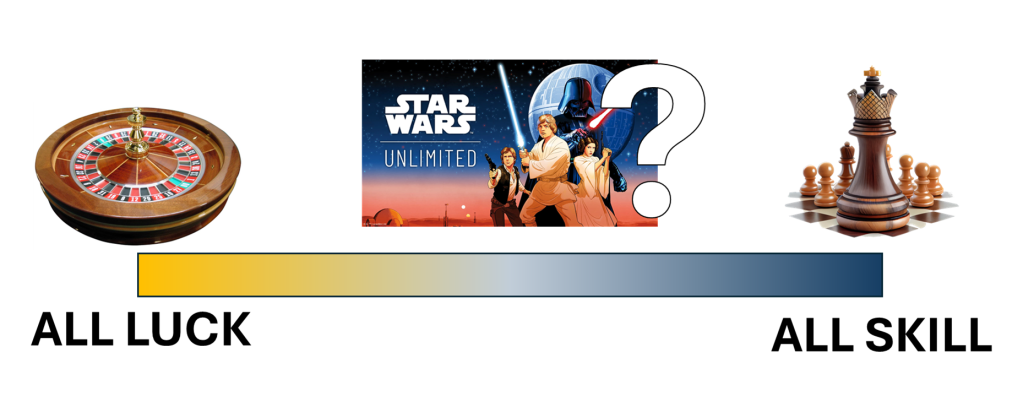
If you’ve played a Trading Card Game, you know it’s part skill and part luck. Random factors like what cards you get and what cards are stuck on the bottom of your deck make a huge difference in outcomes. Likewise, the factors within your control- what plays you make, their timing, what you choose to target- can mitigate the impact of those random variables. But not all card games have the same balance of luck and skill. So, if we were trying to assess SWU within the pantheon of competitive card games, where would it rank?
What is Skill Cap? What is Variance?
“Skill Cap” is a gamer term for the upper limit of how far skill can carry you in a game. In Chess, for instance, the skill cap is basically infinite. Since the game has perfect symmetry and perfect information, the best player should prevail every time. The only question is: how good a computer are you? On the other end of spectrum are gambling games like Roulette. Since the results are random, and what passes for strategy is just vibes, literally anyone could win at any time. The technical term for this difference is Variance, i.e. how different are the conditions from one game to another? Going back to chess, the setup of the game never changes, so variance is extremely low. Meanwhile, the output of our roulette wheel is 100% random, guaranteeing no discernable patterns in play.
All TCGs are somewhere in the middle of this spectrum. They collectively feature mechanics that drive variance in opposite directions. The most obvious is drawing cards from a shuffled deck- you won’t get the same every time. Likewise, the hidden information of not knowing what is in your opponent’s hand creates space for imperfect decision-making. Fighting these forces in the opposite direction is the agency players have in building their decks and sequencing their plays in-game.
What TCG attributes impact variance?
Beyond the common drivers of variance all TCGs share, the rules and design of an individual game can impact variance. Let’s take a look at a few and where SWU falls in the spectrum:
- Deck Size/Card Limits – The number of cards you bring to a game influences variance by determining how easy it is to draw into combos you rely on. For instance, the 30-card decks of Star Wars: Destiny produced very consistent games, while the 60-card decks of Magic: The Gathering can demand more improvising. How many of an individual card you can put in your deck also matters. Games without card limits like the Decipher-era SWCCG (in which you could literally fill your deck with 59 of a single card if you wanted) had very low variance and a high skill cap. SWU, with its 50-card decks and 3-per-card limit is roughly in the middle of this range. The designers talked in the early days of the game about wanting to hit a “sweet spot” when it came to consistency, and my sense is they found it.
- Mulligans – The most important cards you draw in any card game are your opening hand. Games with more generous re-draws like SWU, Hearthsone, and SW:Destiny gain consistency from those opening rules. Likewise, more restrictive mulligans add variance to games like Pokémon or Flesh and Blood.
- Tutors – “Tutor” is a term borrowed from Magic that refers to any effect that searches your deck for a particular card. The more tutors a game has the more consistent, and less variable, games will be. Pokémon and Yu-Gi-Oh! employ lots of these, while SWU’s use of tutors has been limited.
- Resource System – Magic is notorious for having higher variance because players need a specific card type (lands) to resource each turn. This leads to scenarios where a player can get either mana-screwed (didn’t draw any) or mana-flooded (drew too many). SWU thankfully avoids this problem and even increases its skill cap through forcing players to make tough resourcing decisions.
- Random Mechanics – This is pretty straightforward. Games with random in-game effects- the coin flips in Pokémon or the dice in SW:Destiny – add more variance. Outside of meme Jar Jar, SWU has avoided these.
- Meta Matchups – The lay of the competitive landscape can also impact variance. If there are lots of “silver bullet” matchups where one deck can simply crush another, then tournament pairing luck is a bigger factor in results. SWU has so far maintained an even meta, with most decks competitive with most other decks. (Palpatine/Sabine matchups notwithstanding!)
Why is variance important?
Some of you might be wondering: why don’t SWU’s designers use the tools above to stamp out variance entirely? Don’t we want the best players to win?
Well, yes and no.
It’s true that playing a game that has consistency, hinges on small details, and rewards skill can be satisfying. It’s also equally important that the game not feel the same every time and that players get a diverse experience. Not all players are the same! Competitive players want the details to matter, but casuals may not want that same granularity- they enjoy the game in broad strokes. While a game hinging on luck in the World Championship may not be ideal, at a fun local, those are exactly the kinds of attention-getting swings you want.
SWU’s designers seem to intuitively understand these differences between players and are actively using the variance tools above to appeal to different groups. While Premiere play caters to competitive players, the Twin Suns format has both a higher deck size and single card limit to crank variance through the roof for casual players. The upcoming Battle of Hoth set is another example. In that context, they’re drastically reducing both complexity and variance to provide the stable, repeatable experience that brand new players need.
How does SWU’s skill cap compare?
There are popular TCGs I can say with some certainty SWU has a higher skill cap than – Magic (with its high-variance mana system), Destiny (with its dice), and Hearthstone (with its random in-game effects). Top Magic players have historically had a win rate around 60%, while the top players in SWU hover around 75%. There are also some like SWCCG that clearly had a higher skill cap, with top player there winning in the ~90% range. SWU is clearly somewhere between these extremes.
Overall, having looked at the factors affecting variance in the game, it’s clear SWU has a fairly high skill cap. The mulligan is generous, the resource system rewards skill, and the back-and-forth action system gives experienced players numerous chances to outmaneuver opponents. SWU’s flat meta has also rewarded players for knowing common play patterns, as opposed to simply lucking into favorable matchups.
FFG may use the tools at their disposal to turn variance up or down depending on the format, but the bones of this game are built for skillful competition.
~~~~~~~~~~~~~~~~~~~~~~~~~~~
Thanks for reading! If you have thoughts on this article or any of our other content, please leave a comment here or reach out to me on Discord!
@DJStormtrooper



 Garbage Rollers
Leave a comment