

When SWU launched, I wrote an article on SWU’s cost curve and how units from Set 1 fit into it. Now that Secrets of Power is upon us, it’s time to expand that series with an examination of Set 6’s cards and mechanics. Let’s have a look at the new mechanics and cost trends hitting us this week.
As a reminder, the basic formula of the game goes like this:
A basic, 1-cost ground unit has four stat points. Space units have one less stat point than ground units. From there:
1 resource = +2 stat points = 2 direct damage = drawing 1 card = 1 shield = 3 healing

When talking about effects and their value, I like to use a what I call “Resource Equivalents” (RE). The idea is that we can quantify the effect of anything happening in the game, even if it’s not directly transferrable into resources. For instance, you do four damage to a unit – that’s 2RE. If you draw three cards- that’s 3RE. You get the picture.
New Mechanics:
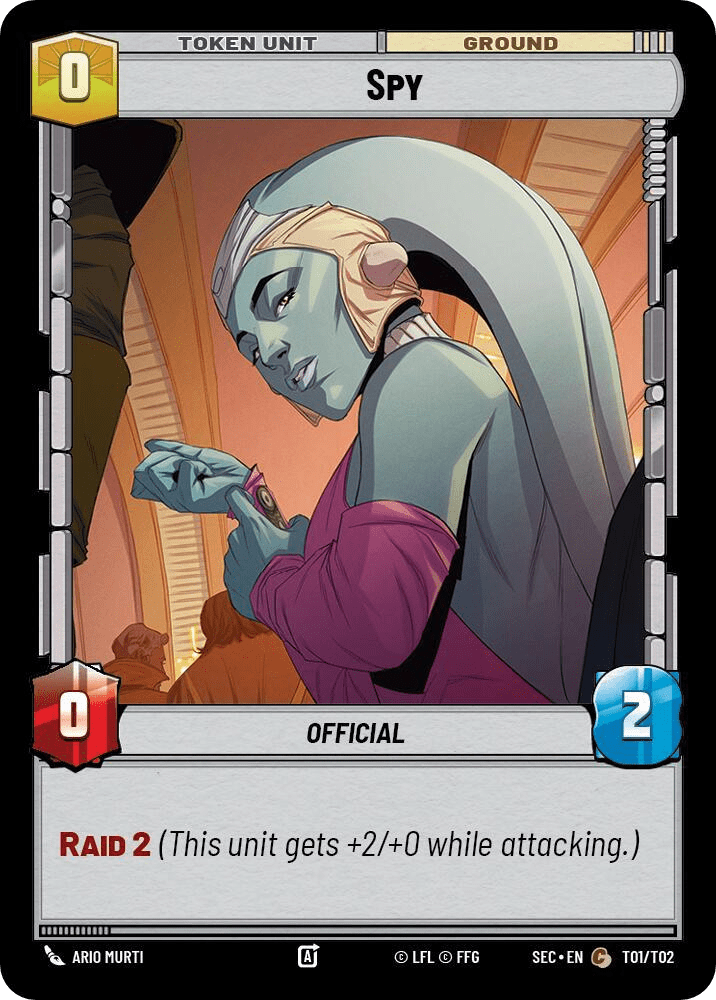
Spy is a new token in Secrets that’s a 0/2 with Raid 2. In Twilight, we got 2/2 Clone Trooper tokens that were costed at 2 but never economical enough to see competitive play. The good news about Spies is that while they have less stats, they cost 50% less. The designers have set the cost of a Spy at ~1 resource. This makes token swarms in the ground arena a real possibility where they simply weren’t before.
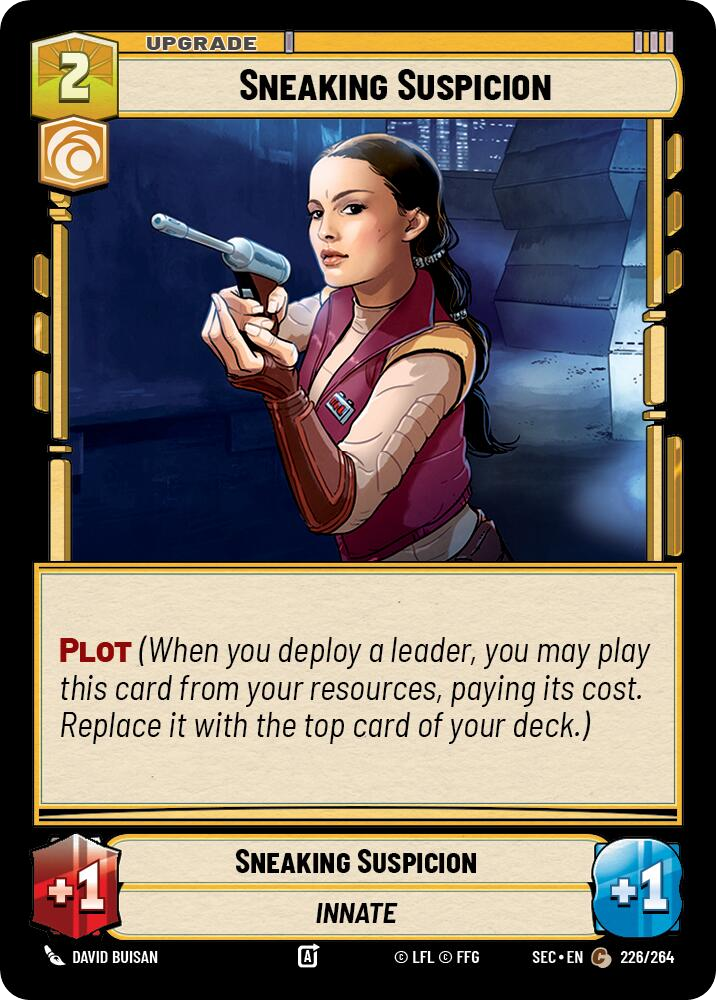
Plot is a new keyword that allows the card to be played directly from the resource row when you deploy your leader. Since playing a card from resource row is kind of like drawing a card, we’re getting 1RE each time plot is used. Accordingly, we can value the Plot keyword at one resource.

Disclose is a new mechanic that has players reveal cards from their hand to either avoid pains or make gains. The best way to think of Disclose is as a conditionality – you’re not always going to be able to satisfy it. For simplicity, the easiest way to process them is that you’ll hit the disclose about 50% of the time. That will obviously change depending on the deck and the size of the Disclose, but to start with, the safe approach is to treat each Disclose effect as a tossup.
So, if for instance, you’re evaluating the playability of the Bardottan Ornithoper above, you’d need to start with a straightforward reading of the stats (3/4 in space = 3RE), then add the effect (draw a card = 1RE), and then finally discount for the Disclose (1RE for draw = ~.5RE with Disclose). This gets you to 3.5RE in total. The upshot is that our Ornithopter is below curve since its Disclose won’t be on 100% of the time.
You’ll want to look for Disclose cards with effects powerful enough to overcome the inherent unreliability of the Disclose requirement.
The Best and the Worst
In the second year of SWU, the designers are proving more adept than ever at making cards that fit within the good enough but not too good zone. That doesn’t mean there aren’t still some standouts in this set that push the curve!
Undercosted: Queen Amidala

If making a Spy costs 1 then we’re getting QA’s strong 5/3 body for essentially 3 resources. Where she really comes in over curve is that her strong damage-replacement ability for free. That ability makes her, in effect, multiple instances of a 5/3 unit- and solidly above curve!
Overcosted: Let’s Talk
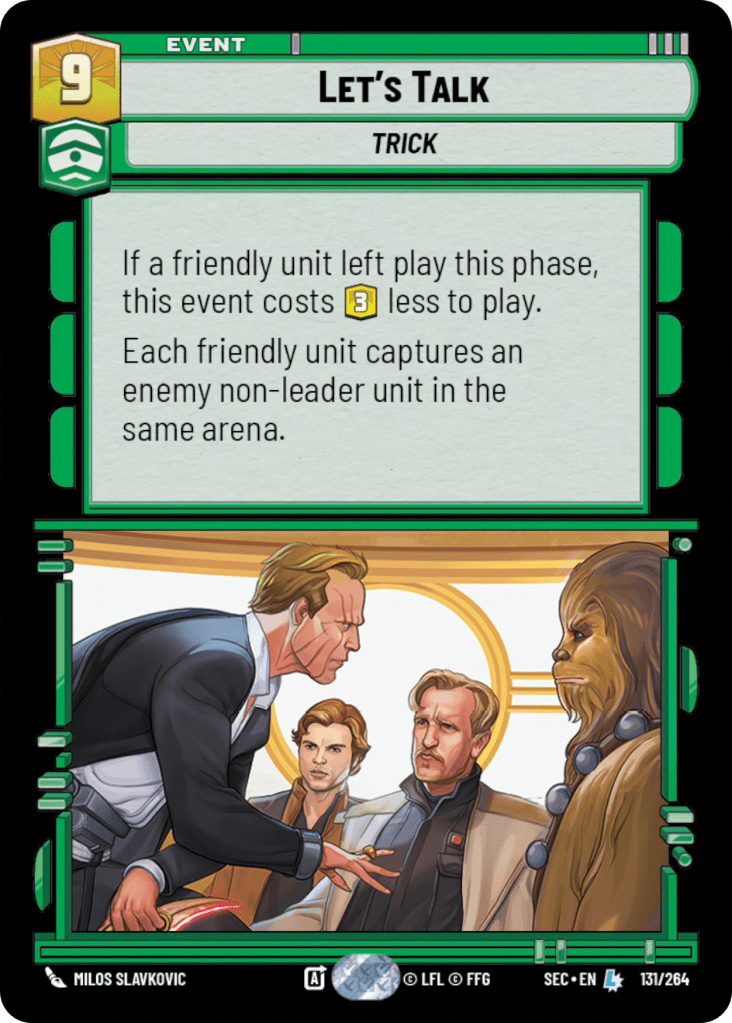
Let’s Talk is massively overcosted, certainly the worst legendary in the set, and destined to join the ranks of SWU’s $1 legendaries. If we were simply costing the ability effectively, where would we put it? History has shown that SWU’s competitive capture effects cost 2– think Legal Authority‘s conditional capture with +2 stats or Relentless Pursuit‘s capture + shield. So, given the boardstates we commonly see in SWU, this card will net you two captures, on average. Therefore, it should cost 4. Right? RIGHT?!
Nope. That’s a NINE in the upper left corner.
Undercosted: Karis Nemik
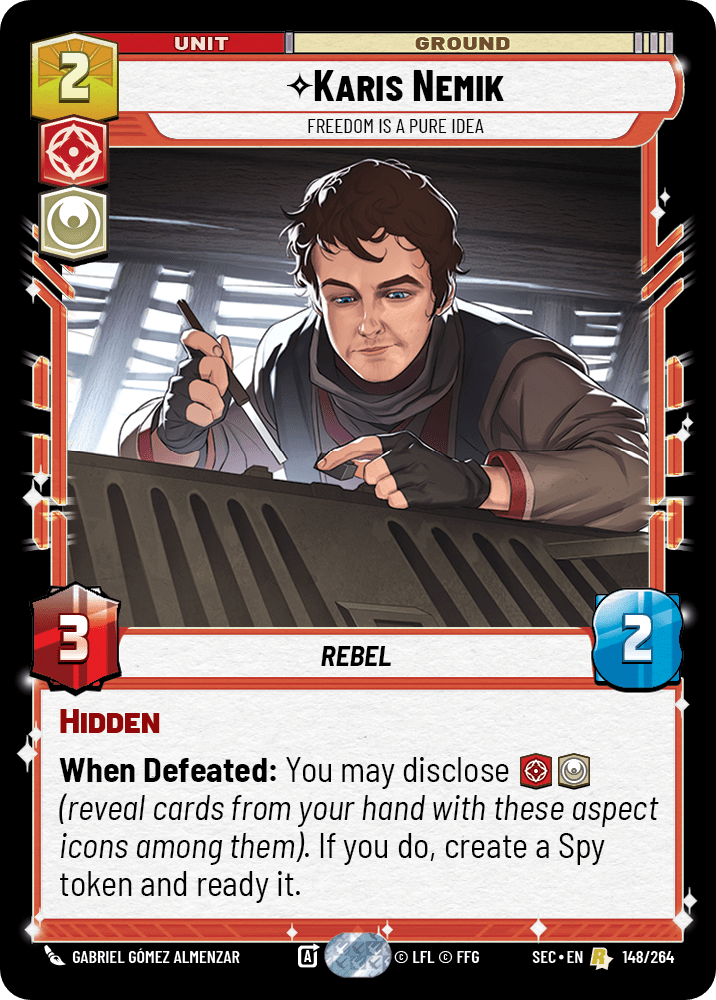
A standard 2-cost ground unit should give us 6 stats. Nemik has 5 with the Hidden keyword, which, while not the ideal, does put us roughly on balance from a costing perspective. That’s where his ability zooms in to make Karis one of the best cards of the set. His disclose is relatively minimal meaning we don’t need to heavily discount the 2RE (generating a Spy + readying it) he’s providing. Overall, Karis is giving us ~3.5RE in value off of his initial 2 resource cost.
Overcosted: PreMor Personnel Carrier

An 8-cost space unit should give us 17 stats to be on curve. As is, PMPC has 12 with the Overwhelm keyword making its stats the equivalent of a poor 6 drop. That means we’re two resources underwater as we scroll down to the ability. Unfortunately, the ability is highly conditional AND does nothing to affect the board. When we’re looking at 7+ cost units (our “bombs”), it’s essential that those units provide an immediate impact on the board since there is such a high likelihood our opponents will use removal on them. As such, PMPC requires setup to get its stats to curve and provides no effect on the board. It’s a total brick that’s at least two points overcosted.
Undercosted: Chancellor Palpatine
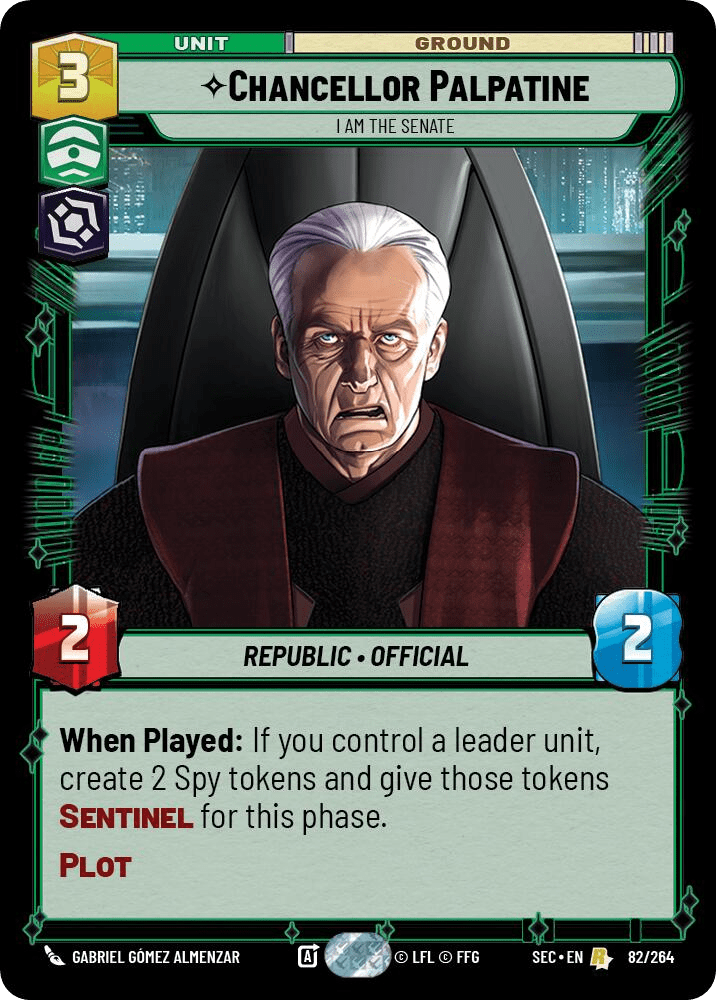
The Chancellor is a whole basket of goodies. While his body is an unimpressive 2/2 (1RE), provided we play him at the right time, we also get two Spies (2RE) and they come equipped with temporary Sentinel (let’s say 1RE). On top of that, he has Plot allowing him to be played from the resource row (1RE) and protect the leader. Since the combination of effects here adds up to 5RE, I wouldn’t be surprised to see Palpatine in Hero decks, as well as Villain, as including him can enable Anakin.
Overcosted: Undercover Operation
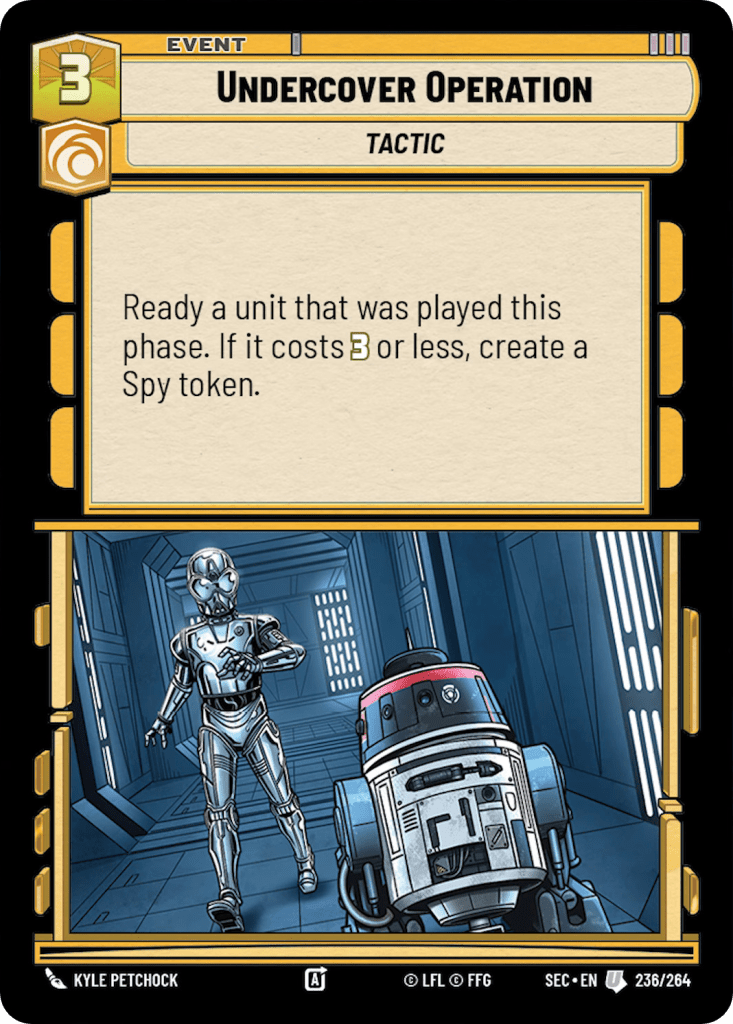
Readying a unit is an effect that should cost us around 2 resources. Creating a Spy is an effect that generates 1RE. So, at first glace, this looks like a simple, on-curve, neutral card. Where things go wrong is that both effects have conditions. Having to ready a unit you played this phase means by necessity playing well under curve for the turn and the 3-or-less limitation on the spy means we’re locked into never getting on curve value out of this event. I could have gotten on board with this if the “played this turn” condition wasn’t there.
Undercosted: Captain Typho

A 4/5 for 4 is one stat point under curve for a 4-cost unit, but Sentinel is typically worth at least two stat points, putting Typho over curve simply on his stats + keyword. From there we get the additional value of his Disclose ability which can provide base healing for minimal requirements. Typho is joining the ranks of the best ground sentinels in the game!
Overcosted: Tempest Assault
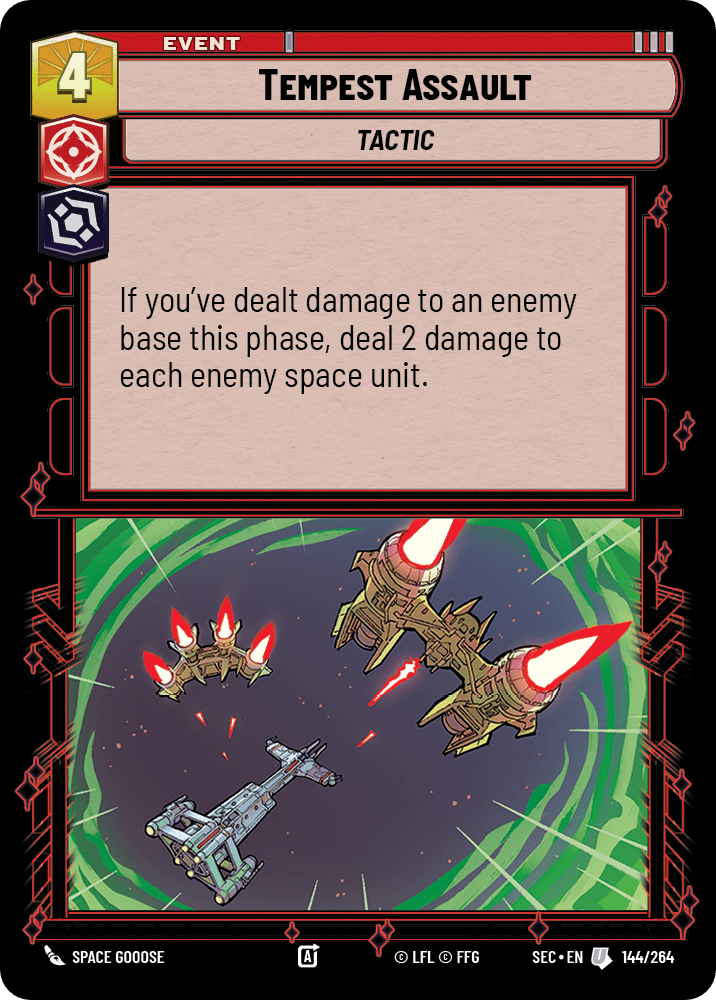
Dealing two to all of your opponent’s units in one arena is not a bad effect on paper. But thanks to Tempest Assault’s dual conditional requirements, it has neither the flexibility of Bombing Run nor the economy of Blood Sport. For this card to give you a return on investment, your opponent would need to have at least 4 space units. That’s not an unprecedented situation, but how many Vader4 counters do you need in a deck?
~~~~~~~~~~~
Thanks for reading today. Do you agree with these being the set’s cost outliers? Please reach out to @DJStormtrooper on Discord with your thoughts!




 Garbage Rollers
Leave a comment