

I spent my time in the military serving as a Logistics Officer. There was a lot of paperwork and personnel management, but the overriding concern of my organization was ultimately one thing: efficiency. How do we bring the most capability to the fight with the least effort? My CCG career started before the military and has extended well after it, but that period of my life left me with a profound appreciation for cost, both as a player and designer.
So, when Star Wars Unlimited spoilers began, my first questions were about the game’s cost structure. How much weight did the game’s designers put on each mechanic? Where did they go wrong applying those rules? The answers to those questions will allow us to identify cards that might be under or over-costed.
Since we’ve seen lots of cards now, we can decode the system the designers built and re-engineer their costing table. The basic formula of the game goes like this:
1 resource = +2 stat points = 2 damage = drawing 1 card = 1 shield = 3 healing = exhausting a unit
Some of these relationships are very explicit – Repair or Daring Raid, for example. Other cards will combine these relationships in more complex ways. But before we start looking at how individual cards fit into this system, we need to talk about some related factors:
Units, the Curve, and Keywords
A 1-cost, basic ground unit with no ability should have four stat points. Every additional 2 points of stats added, we can expect cost to go up accordingly. This means a 2-cost unit with 6 stat points would be “on-curve.” Playing units in subsequent rounds that match this statistical progression would also be on-curve.

Knowing where the curve is lets us assess the weight of each ability or keyword added to a unit. Take Echo Base Defender. As a 3-cost unit, he should have total stats of 8, but there’s only 7 printed- indicating that the designers view Sentinel as a powerful keyword worth sacrificing power he should otherwise have.
Here’s a list of keywords from Set 1 and how they’re costed. In this case, [Integer] refers to keywords like Raid or Restore which have accompanying values.
| Keyword | Cost | Example |
| [Integer] 1 | -1 Stats | Ryloth Militia |
| [Integer] 2 | -2 stats | Cantina Braggart |
| Ambush | -2 stats | Cloud Rider |
| Grit | -1 stats | Scout Bike Pursuer |
| Overwhelm | -1 stats | Wampa |
| Saboteur | -1 stats | Rebel Pathfinder |
| Sentinel | -2 stats | Cell Block Guard |
| Shielded | -2 stats | Wilderness Fighter |
If you want to see how keywords are costed in other sets, check out our continuing series on this topic!
The Two Different Arenas
The designers of SWU consciously made the space and ground arenas function differently. They didn’t want a game where both behaved the same – that would be boring! The solution was to push units in the ground arena more often than those in space. That means space units will typically have one less stat point than their terrestrial counterparts. An extra point of stats or damage will also go farther in space.
Aspects and Cost
How many aspects a card features has a small impact on its power and cost. You can see this difference when looking at Alliance X-Wing (which has one icon) versus Restored ARC-170 (which has two.) Restored ARC has an ability and Alliance X-Wing does not, despite them having the same stats, traits and cost. The designers did this to reward players for using cards unique to the color niche they’re playing, which helps promote diversity and make for a more interesting game. At a deckbuilding level though, it means more icons equals more power.
Where the Formula Gets Broken
What Set 1 cards might be breaking the rules by providing too much or too little value?
Yoda – Undercosted

A standard 2-cost unit should have 6 stats so this would be an on-curve unit with just his Restore 2. That means we’re getting his draw ability entirely for free along with some choice Force and Jedi traits. Yoda is major value!
Vigilant Honor Guards – Overcosted

As a 5-cost unit, we should be getting 12 stats from the VHG. If this unit just had Sentinel, it might be okay. But since we have both the stat reduction and a conditional on the Sentinel, the VHG is below curve. Since a good ground unit should push the curve a bit, one below the curve just isn’t playable.
Home One – Undercosted

At cost 8, we should get an 8/9 space unit. Since the ship itself has Restore 2, we can lower out expectations to 8/7- so a strict reading of the stats and keywords has Home One slightly below curve… BUT THERE’S SO MUCH MORE. We get a full-fledged 3-cost unit from the discard pile. All our other units get Restore 1. Imagine this was just a 5-cost unit with 7/7 stats and Restore 2. That would be absolutely bonkers, and so is Home One as written.
Occupier Siege Tank – Overcosted
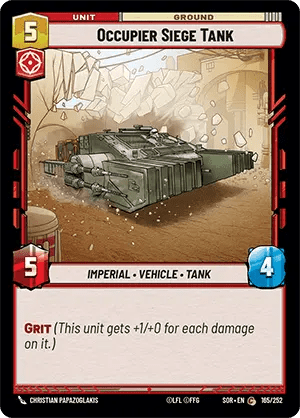
A 5-cost unit should give us 12 total stats and so we start our calculations three points down. Normally, we’d expect a dynamite keyword like Ambush or Shielded given that we’re down a full point on the cost/stats scale. Grit is a good keyword, but only four health to activate it isn’t great, so it doesn’t make up for the below curve stats here. This is before we consider how easily a 4-health unit dies to efficient removal like Takedown or Open Fire.
Shoot First – Undercosted

The fact that this effect only costs 1 is a little crazy. The ability to strike first is huge, allowing this card to easily deal 4+ direct damage – well above the 2 we would expect for its cost. The temporary +1 attack is just icing on the cake.
Mission Briefing – Overcosted

There’s strong circumstantial evidence from cards like Grand Moff Tarkin that the cost of drawing a card should be 1 resource. So, when this card asks us to pay 3 resources to draw two, it seems pretty lame. Especially considering you could have just drawn a good card in the first place instead of Mission Briefing, the three resources to add one additional card to hand is awfully onerous.
———-
Thanks for reading! I’ll be keeping the cost structure in the front of my logistician brain as more cards are revealed!




 Garbage Rollers
Leave a reply to Lezioni per nuovi giocatori #4 – Capire la struttura dei costi di SWU Cancel reply