

What is a Sideboard?
A sideboard is a set of 10 cards that players of Star Wars: Unlimited bring with them to a competitive match alongside their 50-card main deck. These can be any 10 cards (except leaders or bases), but a player cannot exceed the maximum quantity of three of any one card across both their main deck and sideboard. (This article will address sideboards assuming the games take place in a constructed tournament. Draft and Sealed will have different rules.)
How do sideboards work?
Competitive matches of Star Wars: Unlimited are typically determined by a “best two-out-of-three” set of games. For the first game, both players play with their main decks—their primary 50 cards that will be the same for the start of every match. After game one, players have the option to swap in any number of the 10 cards from their sideboard in an effort to make their deck better suited to winning the next game.
Technically speaking, it’s legal to play with a deck of more than 50 cards, but at all times your deck must be at least 50 cards and your sideboard must have, at most, 10 cards. Most of the time, you’ll swap cards 1-for-1 between your sideboard and main deck.
Sideboards win tournaments. Because your sideboard cards can be more specialized—pinpoint focused for a certain task or matchup—they’re often your most powerful tools. Sometimes, sideboarding can be the most important factor in determining how two decks will match up against one another. Building and using your sideboard well will be crucial to your tournament success.
How do I build one?
First, let’s talk about your main deck. The more extreme your main deck is in its strategy, the worse it will be in the next game after you and your opponent sideboard. Put another way, the more your main deck focuses on accomplishing a single thing, the easier it will be for your opponent to counter that thing with their sideboard. Therefore, the ability to pivot from (or to) a more extreme strategy is crucial.
A tried and tested way to plan for this is called the Elephant Method. This involves starting your deckbuilding not with your 50-card main deck, but instead imagining your 50-card main deck and 10-card sideboard as a single 60-card entity. Build that 60-card deck with the goal of having the best tools for all possible matchups. Then, take the 10 cards you think will be the least frequently used, and move them to the sideboard. These will often be counters for strategies at the far end of the cost spectrum. For instance, you might slot in copies of Devotion to counter low-to-the-ground aggro decks. On the other end, you might add Vanquish to your sideboard to counter ramp decks playing large, bomb units like Home One.
Another way to sideboard is building a Transformational sideboard. This means changing the archetype of your deck on the fly during the match. Say your deck starts out as a mid-range deck, but going into game two, you think your opponent could be vulnerable to an aggro rush. Stocking your sideboard with small units and burn events would allow you to play your second game as a different archetype, throwing off your opponent. Star Wars: Unlimited also has the Ground Arena vs. Space Arena dynamic that could make sideboarding units of one type a strategic opportunity. This strategy is higher risk-reward than the Elephant method.
What would this look like in a deck?
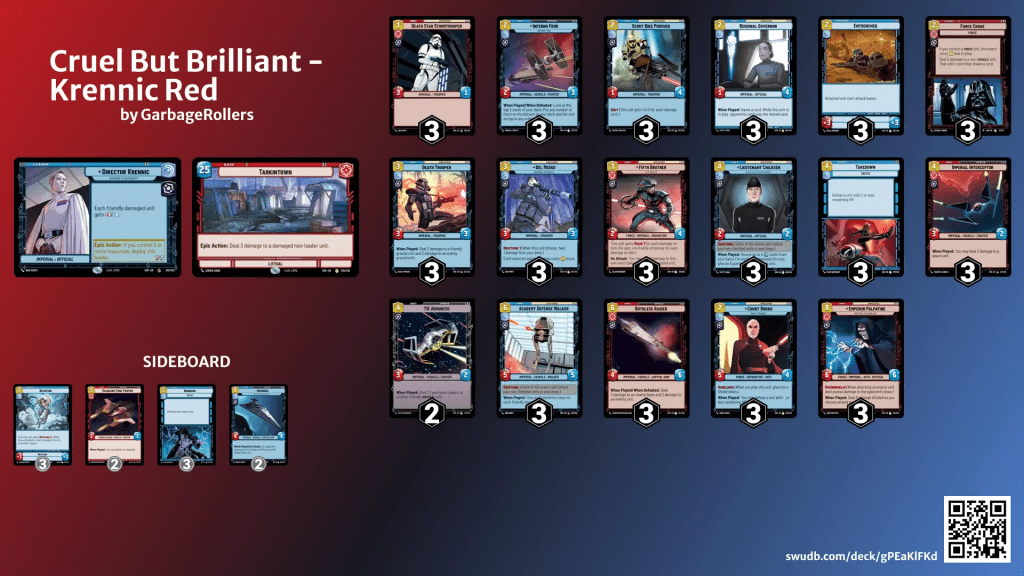
Here’s an example of deck that was built using the Elephant Method. The main deck focuses on mid-range value and all-around effectiveness. The sideboard adds tools for dealing with aggro, upgrades or large units.
In a match against aggro, I’d probably remove Emperor Palpatine from my deck’s high end and slot in Devotion. In a match against control, I’d remove a small unit like the Death Star Stormtrooper for Avenger and swap the cost- limited Takedown for the no-ceiling Vanquish.
Whatever you end up playing for a tournament, the most important thing about sideboarding is the same as it is for your main deck – practice! Playing single games won’t get you ready. Practice like it’s a tournament and do best-of-three with a sideboard. Sometimes, the way two decks match up after sideboarding has no resemblance to the way they matched up in game one. When this is the case, you want to know about it ahead of time- instead of facing a trial by fire in the actual tournament!
Thanks for reading and good luck with your sideboards! Let us know in the comments if you have questions about sideboards or want to share a sideboard strategy you’re particularly excited about!
If you’re looking for a more in-depth take on side boarding from a competitive perspective, check out our guest author Bobby Sapphire’s article about sideboards!





 Garbage Rollers
Leave a reply to Lezioni per nuovi giocatori 8 – Sideboard – Omega Tips Cancel reply