

Hi, my name is Mike Gemme aka BobbySapphire — I’ve been writing about Star Wars card games in their various forms since 1999. I’m currently making video content with my teammates, the KTOD, at www.youtube.com/@SWU_KTOD
When we talk about the value of a card, we’re trying to determine how many of our opponent’s cards we can kill (for lack of a better term) with one of ours. Generally, we speak about this exchange in ratios: “I two-for-one’d them with my Rukh!” or “I got freaking two-for-one’d by my opponent’s Overwhelming Barrage!” In each of these cases, a player used one card to take out two of the opponent’s cards. In those respective cases, Rukh and OB were each “worth” two cards.
Experienced card gamers likely already know about two-for-ones. But, in a new game it’s important to take a look and see what a card is really worth in common gameplay scenarios. Unlimited card values are even more interesting to discuss when we take into account our Base and Leader cards that start on table, have abilities, etc.
A Card By Any Other Name Would Smell As Sweet
In a vacuum, all cards are worth a card, but once we contextualize them, we can begin to understand their expected value. This is, of course, all theory, and when cards hit the table things don’t always go as planned; after all, our opponents are trying to two-for-one us just as hard as we’re trying to two-for-one them.
Cards are also worth one card when they trade for another card of the same cost. We play a Battlefield Marine, our opponent plays a Battlefield Marine, and on the next turn we attack ours into theirs and trade one-for-one. Math so easy even I can do it.
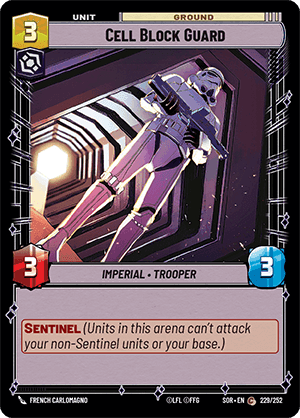
What about when our two-cost Battlefield Marine kills a three-cost Cell Block Guard? Yes it’s a one-for-one, but it “traded up.” Surely that’s worth something, but that value is so minuscule it’s really less than even a half of a card, so we round down and call it an even trade.
What’s a half of a card? The best example I could think of is Wing Leader. The two experience tokens are half of Wing Leader, and the 2/1 body is the other half; when our opponent kills it, they’ve only gotten a half a card of value from us.
What I want to do today is look at just a few cards and card types to try and determine what they’re really worth. I have some general ideas, but I’m hoping this writing will lead me to clearer conclusions.
For those wondering why I even want to do this, it’s because card evaluation is really difficult. We think this card is better than that card, but do we really know? This is one way to figure that out.
Who here is so base?
Trying to assign value to our base is an interesting exercise. Each of the 25 health base abilities are worth half-a-card to a card, but it’s not always cut and dry.

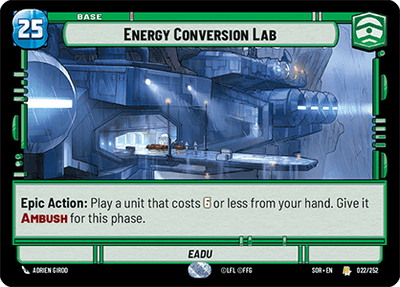
Tarkintown can certainly take out a card with damage on it, and that damage came from somewhere, but if the damage came from something incidental, something not really worth a card for us, Tarkintown can net us practically a full card. Energy Conversion Lab is kind of the same: We use it to ambush in a unit that will hopefully kill one of our opponent’s units. If our unit lives in this scenario ECL’s value approaches a whole card, otherwise we’re costing ourselves at least a half-card of value. Sometimes we ECL a unit only to have it get Tarkintown’d off the board. This is known as “Trading Bases” another example of an even trade.
Security Complex and Jedha City are generally only worth a half of a card. Sometimes a shield can be worth much more depending on what’s being shielded, but there are enough incidental ways to strip shields that I think it’s slightly less. Giving a unit -4/-0 seems like the weakest of the base abilities, but when it allows our unit to kill another unit and live, we’re gaining an entire card of value. It’s slow and situational, and sometimes it only saves us a few health, but when it’s good it’s as good as any of the other bases.
The wildest thing about bases is that they don’t actually cost us a card; they start on table, we don’t need to use them (we’ve all seen games won by decks that didn’t use their base ability), and some people even opt for the non-ability bases for the 30 health.
What bases do best is augment the value of our other cards, creating scenarios that serve as two-for-ones, or one-and-a-half-for-ones (yes, I’m sick of typing hyphens).
I Will Lead Them Up And Down
While bases with abilities show some value, leaders have near infinite value because they really don’t cost us anything – they don’t cost us a card in our deck or in our hand and they don’t cost resources to deploy. Some of their leader-only abilities cost a resource, but a lot of times that’s a bonus that we sometimes take when available but mainly times simply claim the initiative.
It takes two cards to deal with many of the leaders we have in Spark of Rebellion, and that doesn’t necessarily take into account the number of cards that leader has taken out itself. Some leaders like Luke and Vader are great at amplifying combat with direct damage and shields, respectively. Tarkin adds experience tokens, Boba Fett and Han allow us to build out our board with more resources, while Sabine and Leia put us on a fast clock (how many units will never be played because Sabine and Leia won too quickly?!).

Because the stats on most leaders are pushed, it’s much, much tougher to kill them. Leia is one of, if not the most ruthless aggro leader because so few things can take out her 6 health on the 5 Resource (5R) turn, either take two attacks or a really good pump and at least an attack to take them down. Every time a leader “soaks” an opponent’s card (they spend a card to do something that doesn’t kill them), we’re gaining massive card advantage.
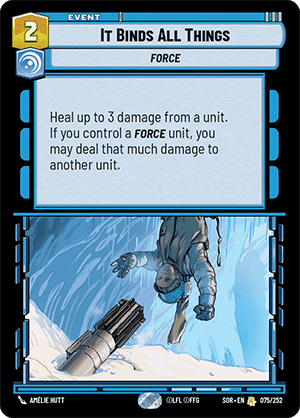
Chirrut and the gambit he creates has become an interesting part of the game since he was spoiled. Do we continue to pump damage into him, overkilling him past the point where he can heal with It Binds All Things or boost his health with Lightsabers and Experience Tokens? As the Chirrut player, we also gamble on how much we want to invest in keeping him alive with those same tricks.
The question of how much advantage we push out of a leader is one that we can apply to every leader. Many leaders trigger abilities on attack — when a sentinel gets in the way do we forgo our trigger altogether or let our leaders get damaged? We could be giving up so much value!
In my opinion, the key is to not get greedy. Yes, if we attack into that sentinel or allow something to attack us we might lose our leader, but if we our leader can take two cards with it, or even help defeat an opponent’s leader, I call that a fair trade. I’ve certainly lost games of Star Wars Unlimited because I was too timid with my leader, and that allowed my opponent to kill it more easily or push past it and destroy my base because I didn’t leverage the card I built my whole deck around. Settling for a two-for-one or seeing the writing on the wall about the longevity of our leader’s time as a unit and taking what you can get will make us better Unlimited players in the end.
Next Stop: Value Town!

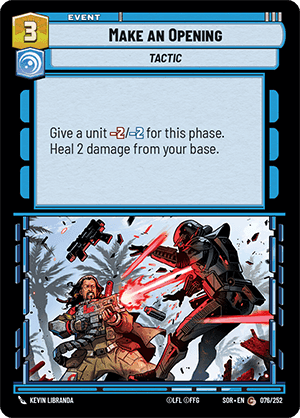
This is getting pretty long, so I want to highlight a few more cards that I think trade really well into our opponent’s cards as two and sometimes three-for-ones. Shielded units, so far, go the furthest towards trading two-for-one in combat. They are susceptible to removal in the form of things like Vanquish, Takedown, Power of the Dark Side, and Make An Opening (boy, blue seems great for control), but otherwise should deal with two cards fairly routinely in most matchups (Vader makes short work of shields). Rukh pushes this to the limit when combined with ECL to kill something, survive most clap backs because of his 6 Health or because you stacked ambush to resolve first and applied his Shielded keyword after combat.
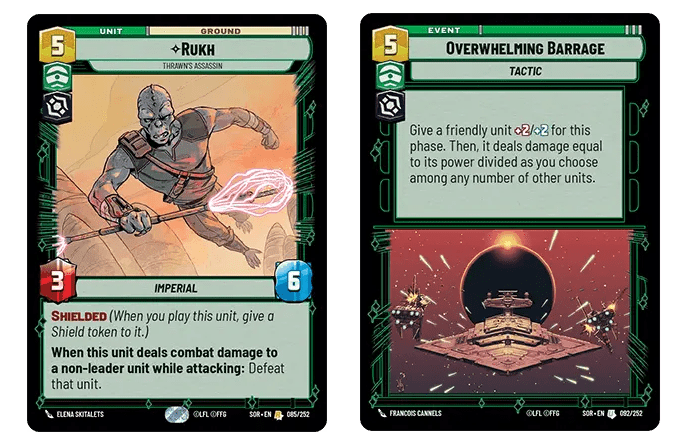
Overwhelming Barrage is a pretty obvious two-for-one or better. One a large enough unit it can kill multiple things, but if you play it into open resources your opponent might be able to kill the unit you targeted with OB and get that value back. I really like Bossk as a two-for-one, he can usually trade with something on his ambush attack and then either take out more cards with his direct damage trigger or our opponent will prioritize killing it, even at the cost of a card, to stop that trigger from popping off.
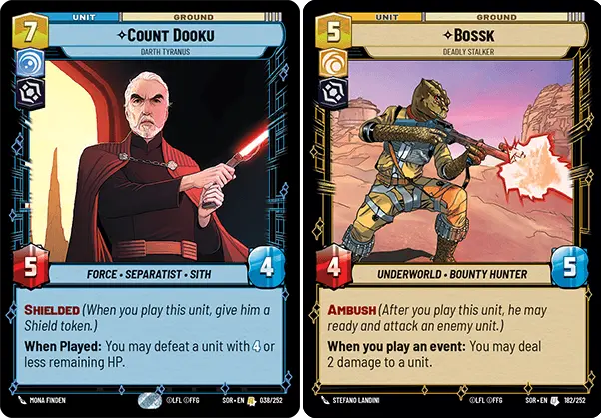
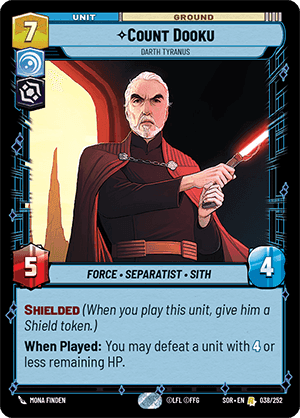
In blue, I’ve really loved Dooku out of Iden and Krennic Control lists. Not only does he kill a unit when you drop him (usually), but he’s also shielded with five attack meaning if our opponent doesn’t have a removal spell or a way to strip that shield, we’re looking at a potential three-for-one. Any card that kills a unit when it hits play is going to provide this value, and each of the three Star Destroyers fit that mold, as they should!

Finally, two red cards that have really stood out to me over the last couple of weeks are Imperial Interceptor and Ruthless Raider (oh, that alliteration!) . So many great ships have 3 health, Interceptor takes them out and makes a trade. Raider does direct damage when it enters and leaves play, creating potential three-for-ones while also doming the base for four. Both of these cards are some of the few units that can single-handedly deal with Fett’s Firespray (though they do it better when paired with ECL [can you tell I love that card?]).

There are so many more cards that provide two-for-one or better value; I could never write about them all – I wouldn’t want to! Instead, I’d love to hear about all the cards you think provide this kind of value! So, comment below, ping me in Discord, or slide into my DMs and let’s talk value!
Thanks for reading,
BobbySapphire




 Garbage Rollers
Leave a comment