
In a few short weeks, March of 2024, Minnesota studio Fantasy Flight Games will release Star Wars Unlimited, a collectible Star Wars card game. The second weekend in February was marked by the Star Wars Unlimited Community Celebration, in which the company invited some of its most dedicated fans and content creators to come learn more about the game.
At the Friday night welcome dinner, I sat across from Fantasy Flight’s Vice President of Strategy Jim Cartwright. The room was buzzing with mutual excitement. Fantasy Flight’s historical catalog of competitive card games is broadly beloved. It is also a graveyard, and one where the epitaphs haven’t always been gracefully chiseled.
The weekend featured nearly 40 guests from across the world being brought in to get to know the team behind the game and experience it early. It was, at first glance, an exceedingly transparent, committed, and considered gesture from a company that has long struggled to earn those adjectives.
My position at the seat across from Jim had a certain serendipity- earlier in the day while filming some games in the Mall of America, we had run into Organized Play Lead Josh Massey. Off the cuff, we asked him a question that we didn’t expect to get an answer to- about what internal changes had led to what we described as a “culture shift” at Fantasy Flight, where communication with players had become much more consistent and transparent. It hadn’t gone unnoticed that senior staff was doing things in the run up to Unlimited that they simply hadn’t done before, such as going in person to gaming conventions to run demos, and having astonishingly open communication channels with the game’s young community.
Josh gave us a wide ranging answer that certainly highlighted the broader team, but was also very clear to point to a single person as a primary source. That person was Jim.
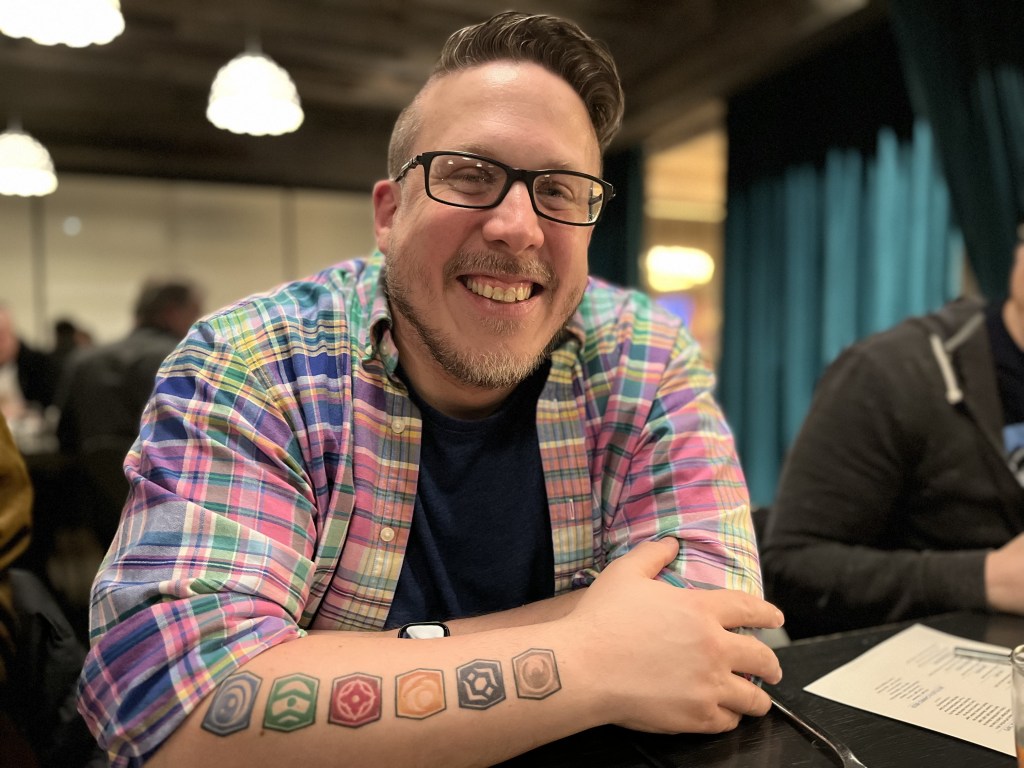
If there’s one quality that defined Jim’s perspective in our long, wide-ranging conversation, it was a sense of accountability for the ways that Fantasy Flight has struggled to communicate and execute in the past. And to hear him tell it, displaying that accountability wasn’t only necessary for the players.
“When we took the initial pitch for Unlimited to Asmodee [Fantasy Flight’s parent company, a global leader in tabletop games] the very beginning of the conversation was ‘Okay, the answer is no, and you’re going to need to change our minds.’ So Asmodee itself started with the same skepticism that our own fans had.”
One can imagine that Asmodee’s concerns were rooted in the company’s previous struggles with logistics. The shadow of Star Wars Destiny, Fantasy Flight’s previous collectible Star Wars card game, has loomed large over the entire prerelease period for Unlimited. Infamously, Destiny surprised the tabletop industry with an unexpected surge in popularity during the few weeks leading up to release. The game, whose bright colors and chunky dice had initially been written off as too unserious by many, won players and industry types over with its novel design and approachability once they experienced it for themselves. Players started buying…until they couldn’t. Demand had so dramatically outsized Fantasy Flight’s estimates that the game sold out almost overnight, and momentum for the game ground to a halt as players waited for more product to be printed.
Even after the initial shortage, later product releases for Star Wars Destiny were themselves almost invariably late. As you might imagine in a room full of former Destiny players, many jokes were levied throughout the welcome dinner about the infamous “On The Boat” product label on Fantasy Flight’s website, where upcoming products would sometimes languish for months with no update. Jim and company were laughing too. They had nothing to hide.
“Our veterans are well known by the community, but there’s also a large part of this team that didn’t exist just a few years ago- Fantasy Flight fans working for Fantasy Flight. And all of us, new and old, know about the biases we’re working against because we were right there, too. We’re ready to be judged against the experiences that people have had.”
Part of those experiences, and what has been the foremost elephant in the room, are those aforementioned production woes. Around the time we were brought our entrees, I asked Jim point blank if players needed to prepare themselves for product shortages with Unlimited.
“No. I’m not worried.” he said. “And you can put that on the record.”

The strategy around what to print and how to print it was one of the things that seemed to fire Jim up the most.
“I want everyone to know how much of the experience is engineered down to the minute details. When we talk about pulling cards, we always say ‘under perfect distribution’. It’s a matter of what we communicate and what we don’t, and it’s been a lot of discussion about that, at every level including legal. And when we talk about printing sets, gosh, we had so many conversations about the number. Daily conversations. This game and the things we asked for just would not have been possible without Asmodee. The ability to be within a larger group that can think bigger was critical.”
“Once they were in, they were in. Man, they really were so supportive.”
“Can you give me an example?” I ask.
“Yeah, one big one was the amount of cards in the packs. They asked us, ‘Are you sure you want to do 16 per pack?’ and we said ‘Absolutely. That part cannot be changed.’ Our entire set designs hinged around being able to support limited play [a format of play in card games where you play with the cards you open in a set number of packs at the event] through that 16 card number. And we didn’t have to go to war for that. We said it was important, and they said do it.”
I asked if broader expansion of tabletop gaming, which has grown rapidly over the last decade, was a factor in Asmodee’s decision to enter the collectible space again.
“Of course. Gaming in general has just seen a big increase in people who are engaging. By extension, that means opportunity has increased. Especially with an IP that matters as much to people as Star Wars.”

Pictured above is a room in Jim’s house- he mentioned that much of the collection had been relocated recently and that he was happy to have it all back together again. Everything on the shelves, he said, was Star Wars.
At one point earlier in the evening while talking about the IP, he mentioned that he’d quit multiple jobs because of Star Wars. I asked him to elaborate.
“Well, when I grew up you couldn’t just watch Star Wars whenever you wanted. It would show up on a TV channel on an afternoon or something. So the opportunities were things I took seriously. I wasn’t going to miss them for anything. When Phantom Menace released, I had carefully planned out a full weekend of seeing it multiple times. When I put in my time off request for the showings and they weren’t approved, I was just like well…bye! I quit over that. And that wasn’t the last time.”
By his own account, Jim comes by this fandom honestly. He described himself as one of the biggest Star Wars fans you’ll ever meet. He’s one of eight children, including five other brothers. All six boys love Star Wars.
All six boys play Star Wars card games together.
“One of my brothers is just a really good player.” Jim said as we were talking about different skill expressions in card games. “I can almost never beat him when we’re just putting constructed decks against each other, he’s too good. But he doesn’t do as much of the building side, so I’m always trying to engineer it so that when we get together we’re playing draft.”
“That’s when I have a shot!” he laughs.
I ask how things were for his brothers when Star Wars Destiny was cancelled, which left the TCG space without an active Star Wars game for the first time since the early 2000s.
“Yeah, I mean it matters to us. When I came up at FFG, I was so pumped because I was excited to work on Destiny. I remember that my first meeting on my first day was an 8:30 a.m., with senior management and the entire Destiny team. I walked in ready to hit the ground running with this game I loved.”
“That was the meeting where they told us that Destiny was being cancelled.”
The fallout of this sudden cancellation, the final sucker punch to a game that never quite caught its breath through its entire run, was a primary source of community hesitation about Star Wars Unlimited. At one point in the evening, Jim asked the whole table, full of longtime card gamers and content creators, if there was anything he could have said on that first livestream announcing Star Wars Unlimited that would have made us feel secure about investing our time into the game. Nobody said yes, which didn’t surprise Jim in the least- and he was clear that overcoming that absence of goodwill was on his mind from the very beginning of Unlimited’s life.
In November of 2020 after a partial Asmodee green light, Jim (then Card Game Manager) and Lead Designer Danny Schaefer (then working on Keyforge) began what he described as a sort of design boot camp where Star Wars Unlimited was born. One of the first things developed in this season was a set of non-negotiable design tenets for the game, the first and foremost of which was accessibility. From the very beginning, this was intended to be a game for everyone, and Jim told us that when things about the working design threatened that ethos, they simply wouldn’t make the cut.
Jim had started at Fantasy Flight as a developer, and with a storied history of playing Star Wars card games, was in comfortable territory as the initial versions of the game took shape. He mentioned to us that back then, a lot of things we’d recognize in the final design were in place, such as Leaders, Bases, and the Space and Ground lanes. A lot of elements didn’t survive, however. With their guiding principles rooted in that initial set of design tenets, the game would undergo drastic overhauls at several points in design. The final product, to hear Jim tell it, doesn’t resemble the initial tests very much at all.
Jim’s insight into the design process was, however, limited by the timeline. For “a lot of very good internal reasons”, he stepped back from the design portion of development in early 2021, after just four months in the tank.
“Ever since that point, my focus has been very high level on what the product should be and should feel like and how we get that across to people. Outside of that initial run, I was not a designer, and truthfully, I’ve been a little worried about the impression that I had more of an impact than I did since I’m over Danny. The reality is that it’s his. I would have meetings with him where I would very clearly put on my Star Wars hat, so that Danny could know that whatever he put out there was safe. I never wanted my ideas to supersede his. Danny at this point was already a senior designer who had been with us for years.”
He takes a drink. “This is Danny’s game. He has driven it since day one.”
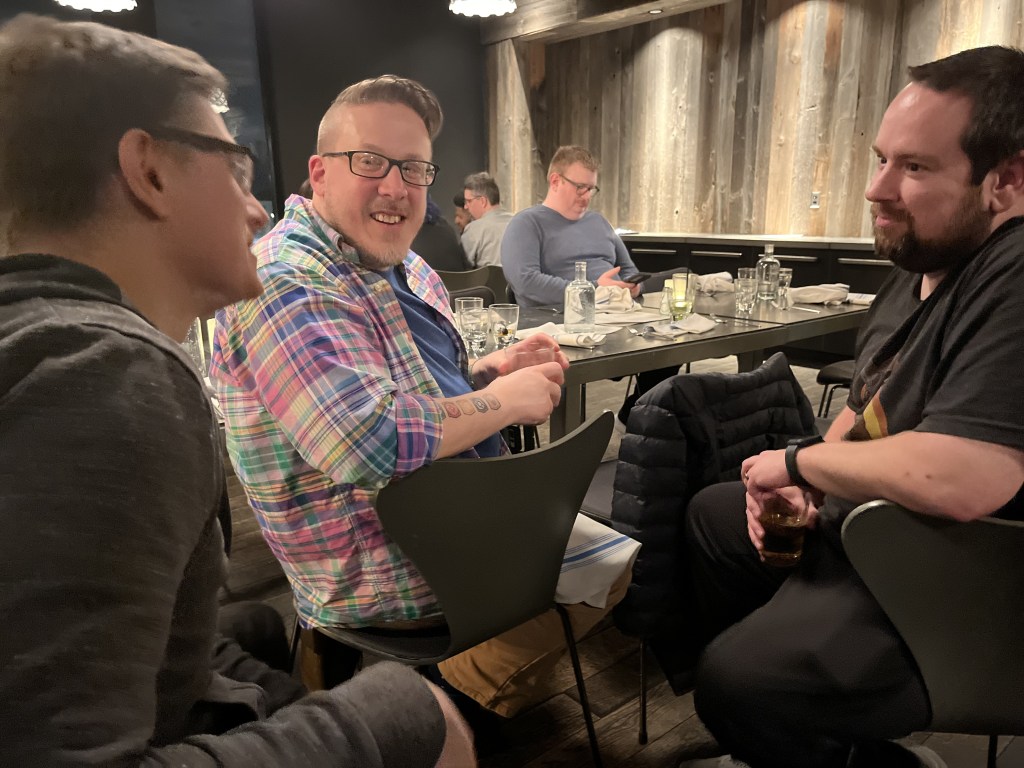
At some point shortly after 11 p.m., a waiter kindly informed us that we did not have to go home, but we couldn’t stay there. There’s something to be said about the kind of conversation that can last for four hours and still feel cut short, but there was more than enough fatigue from a long day of travel to go around.
Even so, all of us were energized. Josh Massey had already spent much of the evening showing off binders of his own Unlimited cards, wielding them like a kid who had snuck an action figure into school. He was particularly proud of his collection of Spectre characters from Star Wars: Rebels, of which he had already acquired nearly every variant. Now, he seemed to be considering piling a bunch of us into a van and just taking us back to his house to play limited. “I have booster displays! We can draft!”. I didn’t get the impression that he was kidding- whatever was stopping him from going through with it had more to do with decorum than anything. Josh Massey, bless his soul, wanted me to come to his house to play a Star Wars game.
The entire night had been a window view into a company that had, against all odds, found a way to love the things they made again.
On the way out, I thanked Jim for his candor and his passion. I told him that I had been inspired by how clear his love for Star Wars, the Star Wars community, and Fantasy Flight’s potential was. I told him that our conversation had helped reconnect me to my favorite thing about my own job; that because I work in local government, I often am lucky enough to go to sleep each night feeling like my work has genuinely enriched people’s lives.
Jim didn’t end up needing to use words to tell me that he felt the same way about his own job. You could see it in his eyes. And in March, I think you’ll be able to see it in the game he helped bring to life.
_ _ _ _ _ _ _ _ _ _
Quickfire Quotes
Thank you very much for reading the above story. I didn’t want to leave out a few topical quotes that I got from Jim that didn’t quite fit into the narrative above, but might prove interesting to fans and prospective fans of Star Wars Unlimited. Be sure to stay tuned to our channels later this week for more articles and videos from this amazing weekend!
- On draft’s role in the design: “Draft was a major part of the design from the beginning. There was literally never a point where doing draft well wasn’t part of the dream.”
- On showcase art: Taking a peek at Josh Massey’s showcase Jyn Erso made his end of the far table a gathering point all evening. Community Engagement Specialist Xander Tabler, Jim, and a couple others talked about the art design process for showcases. “If you’re paying attention, there’s an open secret about showcase art- it’s the same exact art prompt we use for the standard version, just given to a different artist. We loved the idea of the same moments in the saga being depicted from a sort of alternate dimension.” The visual design committee decides which piece will be used for the showcase and which for the standard- and no, as of this writing the design team has not found all 16 showcases from Spark of Rebellion.
- On the lack of guaranteed Legendary cards in each box: “As a player, there was that predictability to opening boxes of Destiny that changed the experience in a way that was talked about a lot. I totally understand wanting that perfect math, but at the end of the day, the surprise and joy when you get those crazy boxes with tons of Legendaries was better.”
- On pack structure: “The details, like I said, really matter. In Set 1 there’s a certain way in which cards are distributed in the packs, and I changed something subtle for the second set. Talk to me after Set 2 releases and I’ll go into more detail. I changed one specific thing. It doesn’t mean distribution is different, but it changes the way that you experience opening packs. That changed between Sets 1 and Set 2, and it actually changes again between Set 2 and Set 3. Like I said, reach back out”
- On Unlimited’s action system and the lack of inherent blocking: “We’re students of TCGs. We talked about the implications of things like attacking with multiple units, and one action at a time versus taking your whole turn at once. We talked about agency for the player, and that came down to pace. If you’re trying to produce a game that’s fast paced, you have to put the agency on the attack.”
- On aspect icons in development: “We played around with the aspect system for a long time, and for a while Leaders actually had all three of the icons. One of the watershed moments of the design was when an aspect icon moved over to the base. It blew the doors off. Now I can make a more Aggressive Luke, a more Cunning Leia, etc. That opened a floodgate of ideas.”
- On competitive and organized play: “Prizing for OP was discussed all the way back to R&D. Doing that part well mattered to us very much. That said, I didn’t meddle much. Ultimately, I have trusted Josh.”
- On Metazoo: At one very tense point in the evening, I asked Jim if the recently deceased collectible card game Metazoo had any impact on the design direction for Star Wars Unlimited. To my surprise, he agreed to answer this provocative question.
“On the record, I can tell you that I’ve never played Metazoo.”




 Garbage Rollers

Leave a reply to Bidding a ‘Roller Farewell: The Best of Jayson’s Content – Garbage Rollers Cancel reply