

The game’s structural factors point that way
For those of you who didn’t play Star Wars: Destiny, a bit of history. Destiny was the spiritual forefather of SWU in many ways and multiple SWU designers (notably Jeremy Zwirn) spent time on that game. From the earliest days of Destiny, there were grumbles about how Villian got the best stuff and particularly how Yellow Villian always seemed to be where the action was. It’s no surprise then that the first world champion deck (Vader/Raider) featured it. Since Destiny had much the same aspect/color scheme as SWU, it’s worth asking: did FFG make the same mistake again?

Haters Gonna Hate, Lovers Gonna Love
SWU’s color wheel gives each color combo a flavor profile that sets it apart. The aspects have their signature focus while heroes generate goodies and villains, threats. If we look at it in the broadest possible terms, here’s what each color combo is delivering:

Two major takeaways here:
- Heroes have to jump through more hoops. Generating a bonus for yourself is great, but there’s an inherent unfairness in having to find a way to use it. This makes most hero cards combo pieces. You generated a shield? Find a way to use it. You put an extra chump unit on the table? Hope you’ve got the next piece of the combo. Lando leader is the zenith of this. He’s effectively asking you to string together 2-card combos for a minor bonus that then requires MORE combo-ing. You know what’s easier than that? Dropping big threats and making your opponent to deal with them.
- Playing fair is worse than playing tricky. If the goal of a game of SWU is to beat your opponent, playing in a way that gives them less agency and increases your own is always going to better. This is exactly what Cunning does. It steals resources- and readies your own; it steals units- and readies your own. It attacks your opponent’s hand directly, limiting the opponent’s options. To illustrate my point, just look at the level of bomb discounting it took to make Admiral Piett competitive. He’s getting a massive 2-resource discount on some of the best ships in the game and you know what? He’s still worse than the best Cunning decks- because he’s playing fair.
Bounce, Bounce, Bounce, Bounce, Bounce, Bounce, Bounce
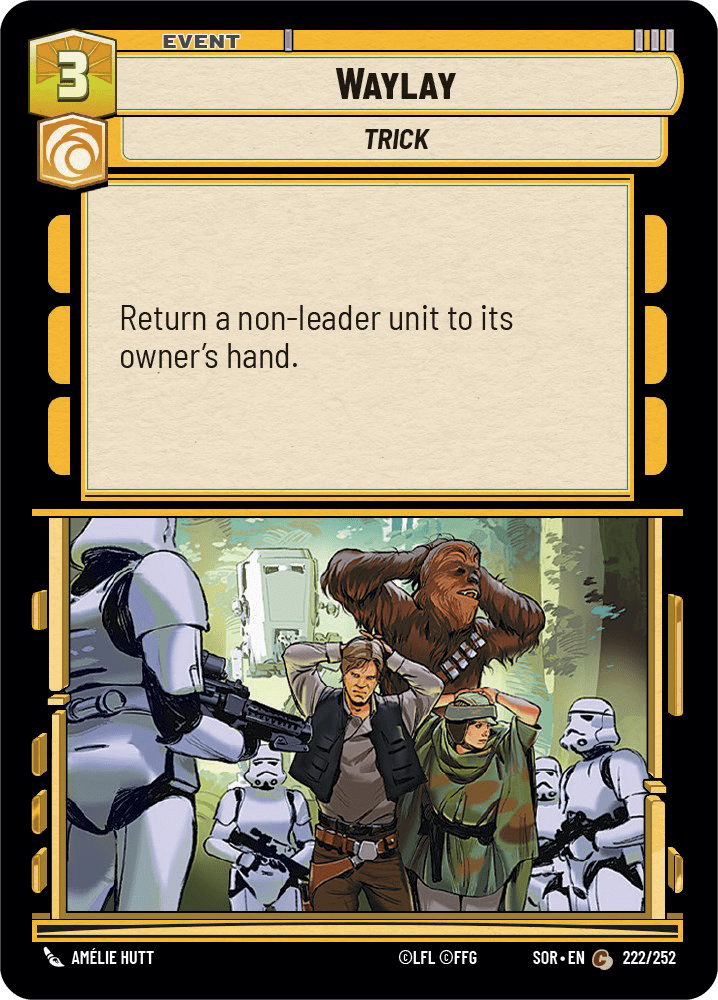
Before we move on, we need to talk about Bounce. All customizable card games have some kind of effect for putting played cards back into an opponent’s hand, and SWU is no exception. It’s what’s known as a tempo play. Fundamentally, you’re trading short term benefit (the unit is off the table) for the long-term pain (they still have it and can play it again.) However, SWU’s two-cards-a-turn structure makes these effects more powerful than they’d be in a game with only a single draw each turn. Because each player draws two, card advantage just isn’t as much of a thing. It’s twice as hard to burn down an opponent’s hand and force them into top-decking. It’s also 50% less helpful for them to get a played card back into hand. On the flipside, the person making the bounce/tempo play gets twice as many options in hand each turn, allowing them to sustain their tempo plays over a longer period of the game before stalling out. Throw in the rules around upgrades and how they slough off into the discard pile when a unit is bounced and the picture becomes clear: bounce is overpowered.
Step in the Name of Cunning
Cunning Villian is just the best. And it would be easy to blame this imbalance on the humans involved. The FFG designers have repeatedly stated that yellow is the “designers color” that they love to work with. Jeremy Zwirn had a well-documented affinity for double-Cunning that I’m sure played no small part in the actual Cunning card being the most powerful of the double aspect cards to date. DJ and War Juggernaut are overpowered and running them with the current suite of Cunning cards magnifies their brokenness. But focusing on those people-level issues masks the bigger, structural forces at play here.
Villian Yellow is the best color in the game, and it probably will be for the foreseeable future, because Cunning has the tricks, and Villain gets to present the threats. And that’s not as simple as “Jango is overpowered,” or “Boba has too many stats.” It’s an inequity baked into the game at the most fundamental level.
We’ve now had three metas dominated by yellow leaders. Anybody for a fourth?
Thanks for reading the GarbageRollers!
Agree? Disagree? Hope y’all will sound off on Discord with your thoughts!




 Garbage Rollers
Leave a comment