
For most deckbuilders, Star Wars: Destiny was a fun game, but a bit of a letdown in terms of the color pie. The game was often dominated by “rainbow” decks that ran all three colors and therefore had essentially no deckbuilding restriction. Furthermore, there was no fixed incentive to run only a single color. Sure, you might squeeze some consistency out of a few cards by always having a particular color available, but that usually wasn’t enough to make up for what you lost in power level by sacrificing a second color.
When SWU was first announced, I was excited about the aspect system. It was going to solve both of these problems! First, the leader/base combo essentially banned rainbow decks, forcing players into a maximum of two colors. Second, the existence of double aspect cards meant that double-aspect decks would get exclusive support that could offset the heavy cost of losing a second color and its associated power cards. The hype was real!
The Early Good Stuff
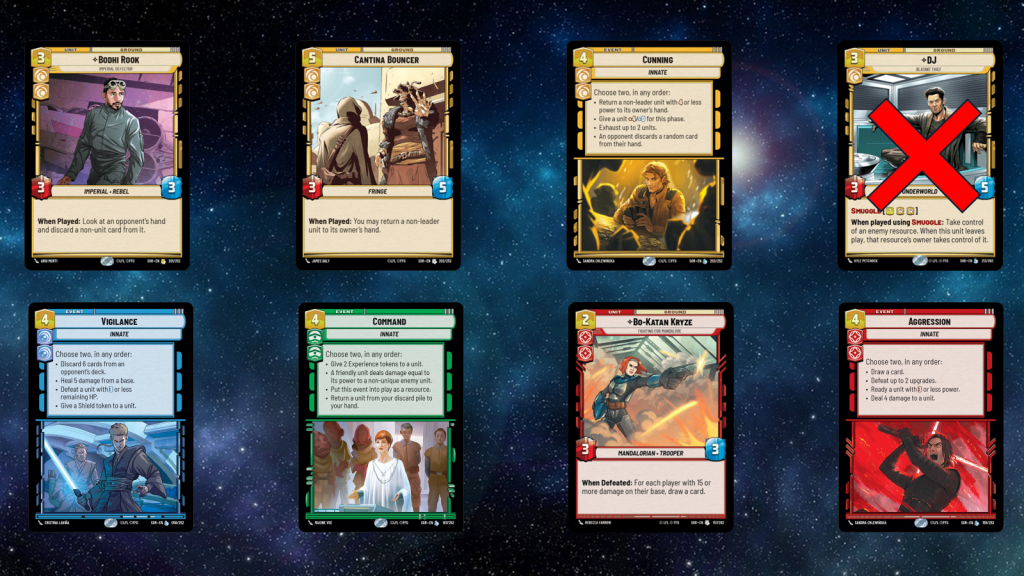
In the Spark of Rebellion meta, and into Shadows of the Galaxy, this system worked. Not all the mono cards were powerhouses, but there were enough cards at high power levels that a variety of mono decks like Boba1/Yellow, Han1/Yellow, Sabine/Red, Kylo1/Red and Iden/Blue were all playable in their times. The key was that this corpus of cards was all costed approximately one point lower than their non-mono counterparts. The 5-cost Cantina Bouncer is basically a Waylay (cost 3) stapled to a Liberated Slaves (cost 3) meaning we’re getting a solid discount in exchange for forgoing a second color. Going into Twilight of the Republic, it seemed like this costing trend might continue and we’d see mono decks continue to participate in the meta.
The Fall of the Republic
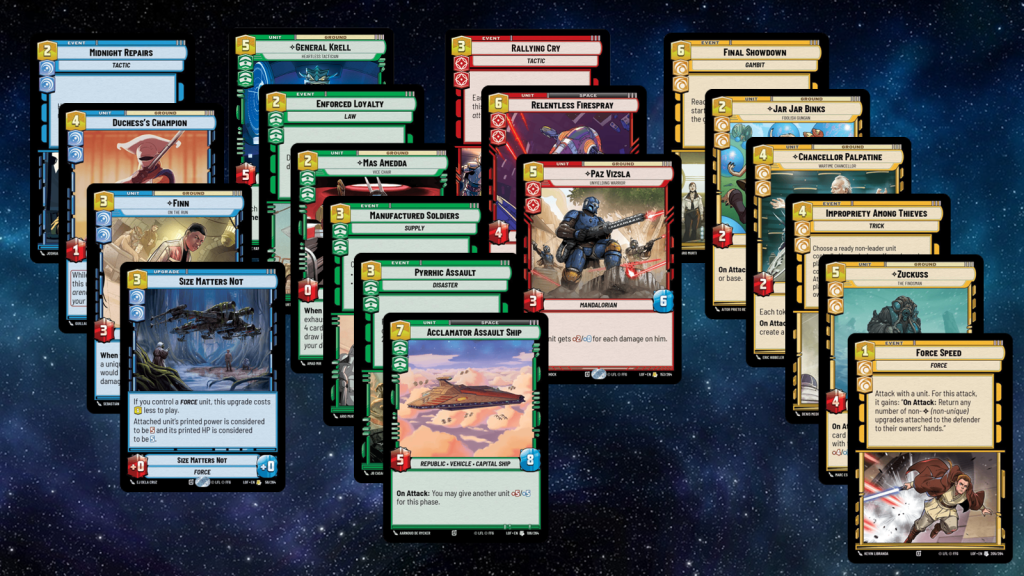
Twilight turned out to be a design misstep on many levels, but it was particularly bad for mono cards. Outside of the intentionally (and hilariously) unplayable Jar Jar Binks, all the mono cards from Twilight flopped. To add to this, DJ was subsequently banned, meaning the pool of playable double aspect cards actually shrunk over this period. And as other color combinations continued to get new power cards and synergies, mono strategies could no longer muster the competitive umph to keep up.
Year 2 and Stagnation
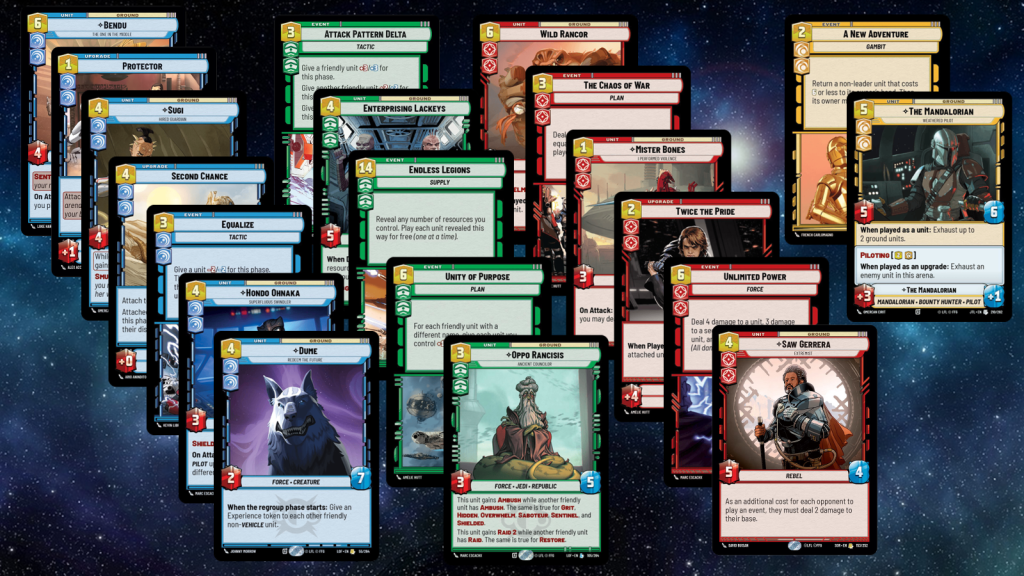
With Jump to Lightspeed inbound and a commitment from the designers to deliver a higher power level, year 2 of SWU seemed like a hopeful time. Mono decks could get back on the map! However, that simply isn’t how it’s played out. The double-aspect cards since have largely been toolbox cards that can deliver a punch in very narrow builds (think Rex/Unity of Purpose) but lack the power level to be generally buildable. Again, the power level standard from Set 1 was that mono cards should deliver a half or full point of cost discount- and we simply haven’t hit that since.
This is Bad for the Game
It’s worth asking: why does this matter? Besides the fact that FFG told us that mono cards would be good… Why am I harping on it? Two reasons:
First, FFG built doubles into the aspect system intentionally, and they did it specifically knowing it would be only for constructed formats. (The extra cost of the cards makes them virtually unplayable in draft/sealed.) But what’s the point of adding niche, constructed deckbuilding tools to sets if they’re not competitive? They can’t be used to plug holes in draft or sealed like other low-power cards. If the double-aspect cards aren’t pushed enough to be viable in constructed play, they just take up space in sets for no reason.
Second, by failing to support double-aspect decks, FFG is essentially shrinking the size of the game’s color pie by 40%. There are 20 different aspect combinations in SWU, with Hero and Villain each having 10 different groupings. However, 8 of those 20 are in the double aspects. With those unsupported, the game actually has smaller deckbuilding space than Destiny did (14 combos) and certainly less than Magic (15) or Lorcana (21.) For a game called Unlimited, the lack of mono support has done exactly the opposite and boxed players into deckbuilding corners.
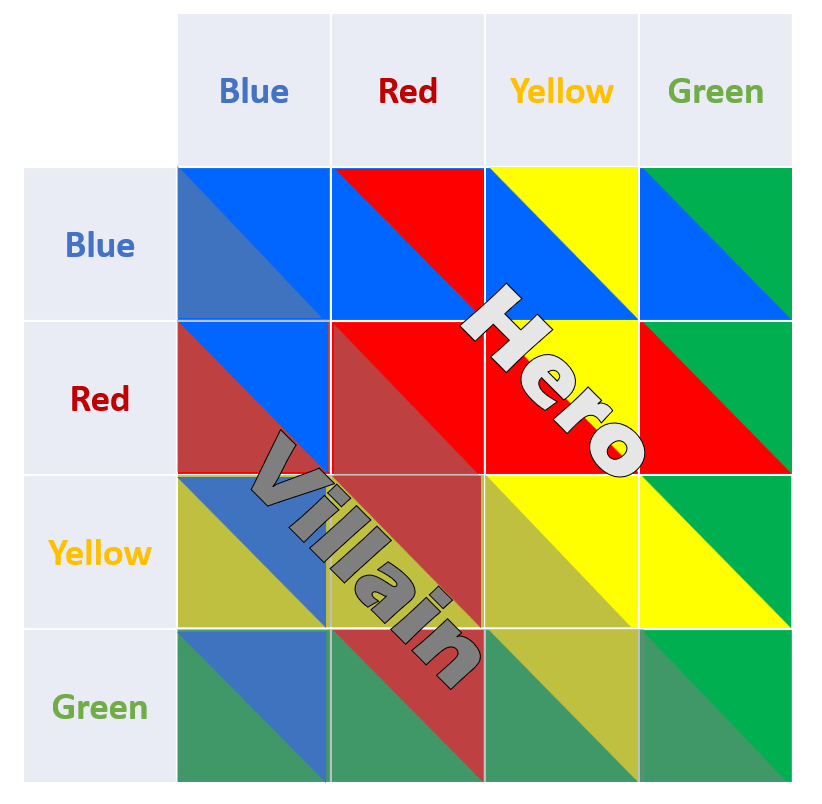
Believe me, writing this brings me no joy. Double-aspect cards are catnip to Johnnys, like me, who love constructed deckbuilding. There’s something exciting about diving deep into an aspect’s core identity- especially one you love and identify with. But the low power level of them since set 2 has left me disappointed over and over. Here’s hoping FFG can right the ship in Secrets of Power. The alternative is conceding that this game isn’t as Unlimited as we were told.
~~~~~~~~~~~~~~~~~
Thanks for reading the Garbage Rollers! As always, please leave us a comment here or reach out to me on Discord @DJStormtrooper.





 Garbage Rollers
Leave a reply to Thorrk Cancel reply